
"At Amber" (“The Bed Took Fire”)


Co-written and produced by Stephen Street, this track was recorded at Wool Hall Studios near Bath, England, in November and December 1988 under the title “The Bed Took Fire.” Andy Rourke and Mike Joyce provided bass and drums, respectively, on the recording, with Craig Gannon and Neil Taylor1 each playing guitar. Producer Street also contributed keyboards. The song was originally intended as the B-side for the “Interesting Drug” single. However, Morrissey was not satisfied with it, and it was ultimately replaced by “Such a Little Thing Makes Such a Big Difference” as the B-side when the single was released in April 1989.
It wasn’t until late 1989 or early 1990, during the recording sessions for Bona Drag at Hook End Recording Studios, that Morrissey revisited “The Bed Took Fire” and asked Stephen Street to rework its production. At some point, Morrissey also had producer Alan Winstanley - who, along with Clive Langer, was producing the Bona Drag tracks - perform additional mixing to enhance Street’s efforts.
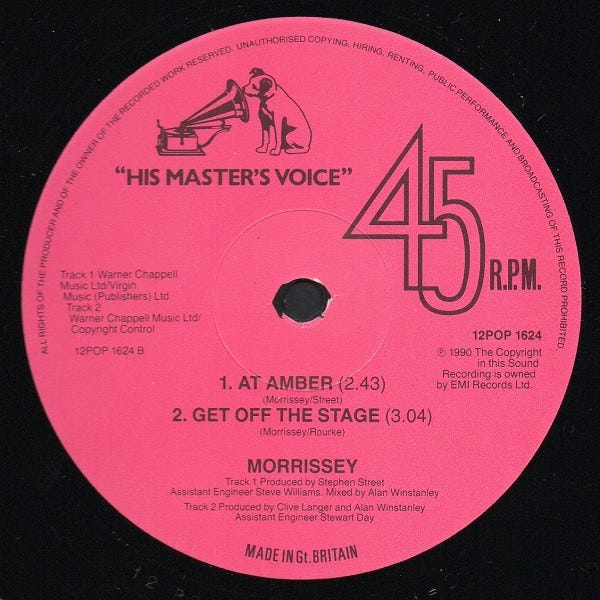
The newly remixed track was retitled “At Amber” and released on 8 October 1990 as the B-side on the 12-inch vinyl and CD editions of Morrissey’s seventh single, “Piccadilly Palare.”
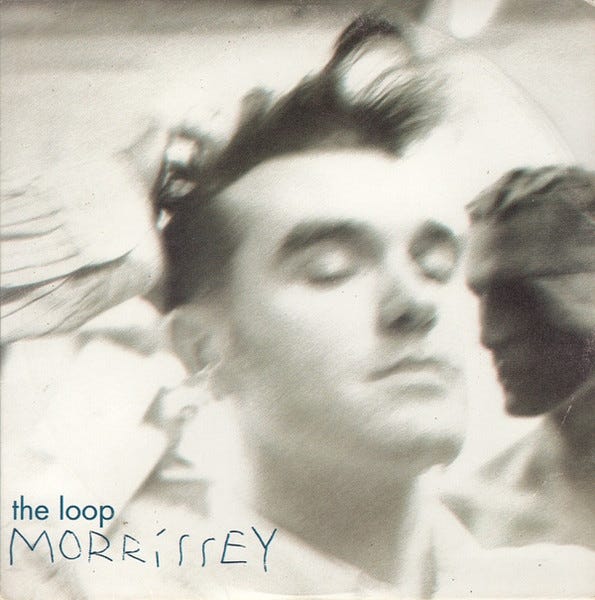
“At Amber” has been re-released several times over the years, beginning in 1992 on a French giveaway CD2 titled The Loop.
This was followed by the 1997 remastered reissue of Viva Hate (the ‘Centenary Edition), where it appeared as one of eight bonus tracks. The song is also the second track on the 1998 compilation album My Early Burglary Years and is included on the 2009 compilation The HMV/Parlophone Singles ‘88–’95.
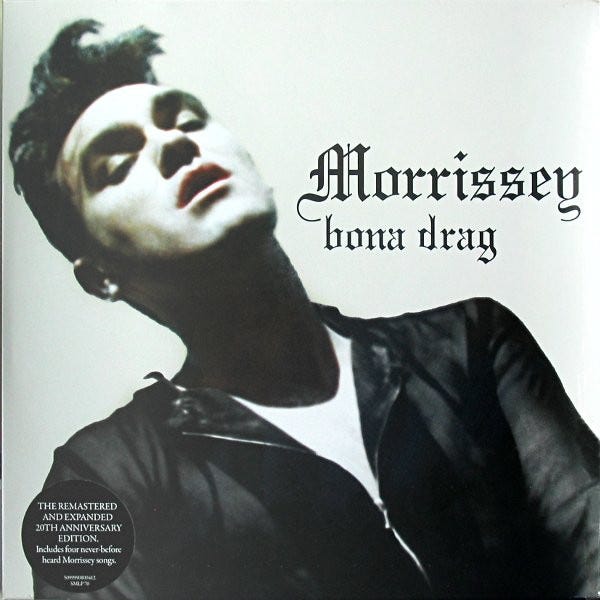
“The Bed Took Fire” in its original form finally saw the light of day when it was released as a bonus track on the 20th-anniversary edition of Bona Drag, a remastered reissue from October 2010.
Reading like an ironic short story in verse, “At Amber” is intimate and observational, carrying a melancholic tone that is evident from its opening lines. The setting is the Sands Hotel3, whose glory days have long since passed:
“I’m calling you from the foyer of the Sands Hotel”
In the midst of the shallow nightlife around him (“…the men and the women are acquainted quite well / And the drunkards keep on drinking”), the beleaguered narrator hovers somewhere between disdain and longing, seemingly stranded in the hotel:
“my room is cold / I’m disputing the bill / I will sleep in my clothes”
The narrator’s attempt to speak to an “invalid friend” about his miserable surroundings is met with a brusque rebuff:
“You slam the receiver when you say: ‘If I had your limbs for a day I would steam away.’”
At first glance, this reprimand suggests a desire for escape, especially coming from someone described as physically handicapped. Yet the phrase “steam away” carries a different connotation, one that can be interpreted as erotic. The narrator’s incapacitated friend is frustrated by the former’s ambivalence, effectively telling him that, if given the chance, he would unapologetically seize it and pursue the carnal pleasures so readily available to the narrator.
The narrator’s inability to leave “this awful hotel” suggests a kind of emotional - or perhaps existential - paralysis that implies a loss of agency. Yet his mid-line self-correction (“And I cannot - or, I do not”) touches upon the presence of choice, revealing one of Morrissey’s central lyrical themes: self-imposed misery, perhaps even spiritual damnation, disguised as fate.
Indeed, the line “…I’m envying you never having to choose” sharpens this distinction: the friend’s paralysis represents a freedom from choice, whereas the narrator’s freedom to choose feels like a form of imprisonment.
This moral - and even existential - quandary echoes throughout Morrissey’s oeuvre. A notable example where it rises to the surface is the track “There’s a Place in Hell for Me and My Friends” from 1991’s Kill Uncle album. Here, fatalistic resignation is rendered almost noble, as Morrissey quietly accepts his fate of eternal Coventry with grim satisfaction. Yet the song also hints at a deeper truth that belies Morrissey’s familiar “woe is me” façade, performing a détourné similar to that discussed in the previous paragraph: he simultaneously states, “We had no choice” and immediately follows with, “We always did.”
This recognition may seem paradoxical, but it underscores one of life’s immutable truths: what is often deemed “fate” is, in reality, the outcome of our choices - choices born of our self-will, or what Saint Augustine referred to as curvatus in se, which Morrissey has rendered into art.
Morrissey has performed “At Amber” live four times beginning on 9 August 2002, at the Celebrity Theatre in Phoenix, Arizona on the first date of his World Tour 2002. He did not perform it again until his Live In Concert 2020 tour, when it was performed at each of the three concerts that transpired before the tour was derailed by the Covid epidemic.
Listen beginning at 9:03 in the following link to hear Morrissey’s debut performance of “At Amber”:
Neil Martin Taylor (born 26 January 1961) is an English guitarist, best known for his long-time affiliation with Robbie Williams and for his work with Tears for Fears.
This compilation of B-sides was given away with a subscription to French magazine Les Inrockuptibles. The offer appeared in issues 37 and 38 (July and August-September 1992)
Technically, the Sands Hotel and Casino. A historic hotel and casino on the Las Vegas Strip in Nevada, it operated from 1952 to 1996. While it was the seventh resort to open on the Strip, it came to symbolize the glamor and excess of Las Vegas’ heyday with its prominent 56-foot high sign. The Sands hosted many famous entertainers of the day, most notably the Rat Pack, Martin and Lewis, Bobby Darin, Nat King Cole and many others. Hollywood celebrities such as Humphrey Bogart and Lauren Bacall, Elizabeth Taylor, Yul Brynner, Kirk Douglas and others were often photographed enjoying the headline acts.
