
I Have Forgiven Jesus
Morrissey's startling commentary on Jesus and Catholicism.

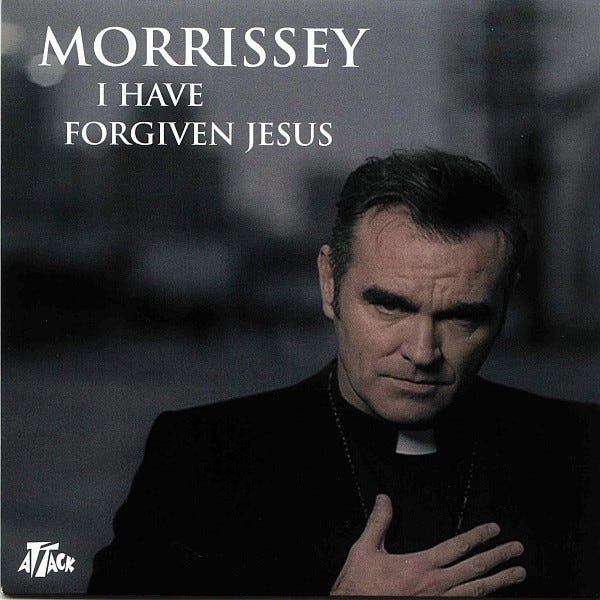
Released December 13, 2004 in both CD and vinyl format, 'I Have Forgiven Jesus' is Morrissey's 30th single. The song is the fourth single from Morrissey's You Are the Quarry studio album, which had been released in May 2004. A promotional music video preceded the single's release. Morrissey appears in the video dressed in the clothes of a Roman Catholic priest (collar and all). Watch the promotional music video for 'I Have Forgiven Jesus' here:
Despite not being played by BBC Radio 11 (one of the UK's most popular radio stations), the single not only reached number 10 on the UK Singles Chart, but also topped the UK Independent Singles Chart!
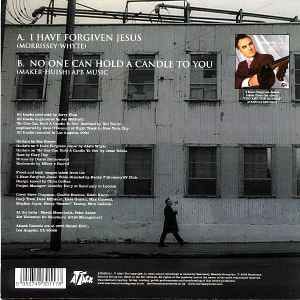
The cover art for the single (for both the front and reverse-side) is composed of photo-stills taken from the promotional music video.
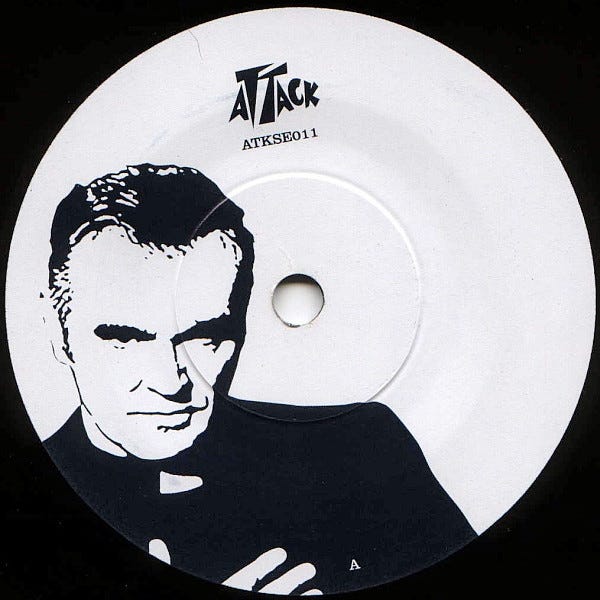
The matrix on the 7-inch vinyl format of the single had DOUG@TOWNHOUSE DAMONT C.P.2 etched on the A and B-sides.
Morrissey has been rather vocal about his dislike of some aspects of his upbringing, in particular being "forced" to attend mass. Indeed, he has described himself as "a seriously lapsed Catholic … after being forced to go to church and never understanding why and never enjoying it, seeing so many negative things, and realising it somehow wasn't for me. I can only have faith in things I see." Quite tellingly, Morrissey has said that "Well, I'm a Catholic by birth and you can never shed it.", which the author can attest to as being a profoundly true assessment. Given all this, it is manifest that Morrissey's upbringing in the Catholic faith directly inspired 'I Have Forgiven Jesus', making the song probably one of his most personal.
The song begins with Morrissey recalling his childhood, being a "good" and "nice" child, which alludes to the concept of the innocence of children.
I was a good kid
I wouldn't do you no harm
I was a nice kid
With a nice paper-round
Morrissey expresses contrition, seeking forgiveness for pain he may have caused an unnamed party. Presumably, he is speaking to a close family member.
Forgive me any pain,
I may have brung to you,
With God's help I know,
I'll always be near to you
Morrissey then expresses that Jesus has harmed him by the act of leaving (having "deserted") him, as well as by creating him the way that he is (which we have no real choice in - ultimately, we are what, and who, we are). It is notable that there isn't a hint of accusation or anger in this; rather, it is sung matter-of-factly. Morrissey plainly states that he's forgiven Jesus for what he has done.
But Jesus hurt me,
When he deserted me, but, I have forgiven you Jesus
For all the desire,
You placed in me when there's nothing I can do with this desire
Morrissey then goes on to lament Jesus leaving him, but not before placing "all the love" in him that Morrissey cannot do anything with ("there's no one I can turn to with this love"). Morrissey then describes what we can assume to be a sort of weekly "snapshot" of his life:
Monday - humiliation,
Tuesday - suffocation,
Wednesday - condescension,
Thursday - is pathetic
By Friday life has killed me,
By Friday life has killed me
Morrissey oddly references a "pretty one" (Jesus?), rhetorically asking them:
Why did you give me so much desire,
When there is nowhere I can go to offload this desire?
And why did you give me so much love in a loveless world,
When there is no one I can turn to
To unlock all this love?
Morrissey then shifts somewhat from the original issue(s), questioning the motives of Jesus given that he has brought forth (into flesh and blood) a being with "self deprecating bones and skin", which is a fairly astonishing statement on a number of levels. This is intermixed with the plaintive, almost child-like plea put into the form of a question, "Do you hate me?":
And why did you stick in self deprecating bones and skin?,
Jesus do you hate me?
Why did you stick in self deprecating bones and skin?
Do you hate me?, Do you hate me?, Do you hate me?, Do you hate me?, Do you hate me?
'I Have Forgiven Jesus' is an incredibly bold and unprecedented song. A mortal daring to state that he has forgiven the Son of God?! Indeed, it would not be an exaggeration to state that some would deem the song as blasphemous, pure and simple. While this assessment would be not unreasonable (even for a lapsed Catholic), we must consider the context, which on its face is not rooted in any malicious intent. Far from it.
Morrissey’s lament acknowledges Jesus (and, rather clumsily, God), though for reasons that are not normally discussed, which makes it all the more startling. Morrissey has accepted his lot in life - he didn’t make himself as he is, and therefore he has no control over who he is. To live such a life (filled with a desire that is condemned by the church) is to live within an eternal dilemma.
The song signals Morrissey’s unwillingness to wrestle with the moral and ethical implications of being placed in such a position. It is not so much resignation as it is an altogether different route than that which is normally travelled. Not only has he accepted who he is, Morrissey goes further, acknowledging the creator’s role in the matter and expressing his forgiveness. This declaration of forgiving Jesus is balanced, perhaps even negated, but certainly explained by his entreaty to Jesus: Do you hate me?
One imagines that Morrissey will need to wait a bit longer to obtain a definitive answer to this question. But then all of us are more or less in the same boat as Morrissey for who each of us are.
Morrissey has accused BBC Radio One of banning his music because the Controller doesn't like him. In an exclusive interview, the cover story of the latest Hot Press, he reveals: "I have a letter from him to my plugger which begins, 'let me explain to you why we will never play Morrissey'... which is alarming."
The decision to ban Morrissey's could be a reflection of the administration's own insecurities, the frontman suggests, in the course of a hugely informative and entertaining interview, conducted by Peter Murphy for Hot Press.
"It's human nature to dislike and even hate other people, sometimes without even knowing why, sometimes because they remind you of something within yourself that you dislike," says the 49-year-old Morrissey, who remains one of the most durable and intellectually stimulating rock icons of the post punk era.
He reveals that the BBC rationalised what amounts to a blanket ban by saying that he was 'too old to be played on Radio One' and that he didn't 'make consistently good music'.
"I found this quite fascinating because it is obviously untrue and also age-ist and possibly racist," he adds.
Hot Press, March 26, 2009
Doug Shearer is a British mastering engineer who has worked at several high-profile London based mastering studios. Shearer performed the lacquer cutting on the vinyl version of 'I Have Forgiven Jesus'. Lacquer cutting is the process of transforming an audio recording into physically cut grooves on the surface of a lacquer disc via a machine called a lathe.