
"I Wish You Lonely"
Tombs are full of fools

Co-written with guitarist Boz Boorer, “I Wish You Lonely” is the second track on Low in High School, Morrissey’s eleventh studio album (released November 17, 2017). Recording commenced in June 2017 at Forum Music Village in Rome and concluded in August at La Fabrique in St-Rémy, France. Produced by Joe Chiccarelli1, the musicians on the song are Boz Boorer and Jesse Tobias on guitar, Mando Lopez2 on bass, Matthew “Matt” Walker on drums, and Gustavo Manzur on keyboards.
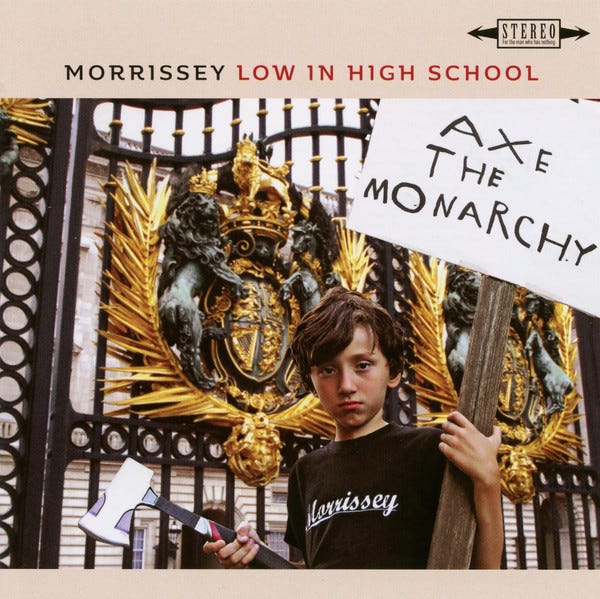
As is the case with virtually all tracks on Low in High School, “I Wish You Lonely” is musically adventurous, perhaps only rivaled by the uncompromising energy and experimentation of many of the tracks on Southpaw Grammar. Long gone is the luminous sound of Vauxhall and I and the polished offerings found on You Are the Quarry.
From its opening burst of discordant synth, Morrissey’s voice rises to the forefront - an impassioned fervor hovering over a broad, ambient bed of shrill, grating textures (not unpleasant) that create a constant sense of agitation.
From a strictly psychological perspective, the first verse of the song offers a window into Morrissey’s pervasive sense of alienation. Rather than asking the listener for understanding, he employs a sort of empathic inversion, asking that we walk in his shoes:
I wish you lonely
if only for one day
so that you might see
routine for me
since the day I was born
The listener is then presented with a rather twisted interplay of self-isolation and pained self-awareness in the second half of the first verse, spoken as a muted and pitiable plea for help. The subject implies that he suffers from insomnia, but goes on to describe a somnolence so profound that it borders on catalepsy. Collectively, this oscillation reveals a common dynamic found in those who suffer trauma or long-term emotional strain:
Think of yourself only
of everything you demand or you want or you need
and to hell, to hell! with everybody else
Turn the key slowly
remember how I can’t sleep
(or, if ever I do, an earthquake couldn’t agitate)
The second verse seems a highly nuanced meditation on both the transience and futility of life, though one detects something of a deeper undercurrent as it involves the loss of human agency:
Tombs are full of fools
who gave their life upon command of
monarchy! oligarch!
head of state! potentate!
Tombs are full of fools
who gave their life upon command of
heroin! heroin! heroin!
Although seemingly disconnected from the opening verse, the two are interwoven, creating a much larger existential statement that is astonishing in its breadth. Threaded throughout this second verse is the repeated line “Tombs are full of fools” who “gave” their lives. Contrasted against the opening verse, one can discern a sort of method to Morrissey’s world and life-view, his isolation and “outsider” status are as much survival techniques as they are crosses for him to bear.
The second verse is clearly a critique of power structures and societal hierarchies that crush individual autonomy (the “command of monarchy! oligarch! head of state! potentate!”). Leaving no stone unturned, the reference to heroin introduces a kind of inverted autonomy: while getting high may appear to be an act of free will, the abuse of illicit drugs such as heroin represents the loss of the self to an external force. Addiction becomes just as destructive - and just as capable of erasing autonomy - as any monarch or potentate.
The issue of mortality runs throughout “I Wish You Lonely” - specifically those who “gave their life upon command…” for things that are “never coming true,” and are now “never coming back.” When viewed through this prism, “I Wish You Lonely” becomes an indictment of the arc of human history, strewn with the futility of lives lost for what, in the balance, amounts to nothing of substantive value.
The song shares a subtle yet direct connection to “I Am Not a Dog on a Chain,” the titular track on Morrissey’s 2020 studio album - a seemingly simple and playful song that deals wholly with the paramountcy of human autonomy, come what may. Morrissey explains in the plainest manner possible that he thinks for himself and could care less about what this entails (cue those who profess to like Morrissey’s music but frown upon Morrissey the man). He has no interest in “going along” for the sake of acceptance; indeed, such a notion is anathema to him.
Distilled to its essence, “I Wish You Lonely” is a statement on human agency in general and Morrissey’s own autonomy in particular, set against the pressures of societal expectation. The song acknowledges the weight of loneliness and alienation, yet offers affirmation to those with the self-awareness and resilience to live on their own terms in a world that is often indifferent, constraining, transient, and fundamentally absurd. Seen through this lens, the song is less a lament than a meditation on survival amid the relentless patterns of human folly. Morrissey’s own story exemplifies this triumph over the precariousness of life, demonstrating that steadfast commitment to one’s convictions can endure beyond the noise, the doubt, and the shifting tides of cultural expectation.
In a Morrissey Central post titled “Lyric Pride”3 dated July 10, 2024, the singer listed “I Wish You Lonely” as number 19 among the songs from which he derives the greatest lyrical self-fulfillment.
Debuted live on 31 October 2017 at the Arlene Schnitzer Concert Hall in Portland, Oregon on the Low In High School tour, “I Wish You Lonely” has been performed in concert a total of 146 times to date.
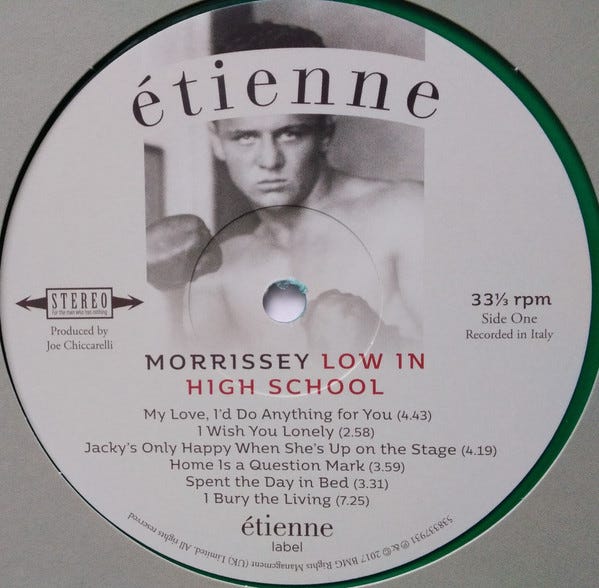
Joe Chiccarelli is an American record producer, mixer and engineer, who is a native of Boston, Massachusetts.
The child featured on the cover of the Low In High School album is Max Lopez, son of bassist Mando Lopez.
https://www.morrisseycentral.com/messagesfrommorrissey/page/60