Madstock 1992
Morrissey's Waterloo in the eyes of the New Musical Express

Beginning in the late 1980’s, Morrissey has been dogged by accusations of racism, which has persisted in some form or another to the present. This charge came to the fore in 1992 when Morrissey performed at the Madstock Festival in Finsbury Park, London in support of the English band, Madness1.
On August 8, 1992, Morrissey performed before an audience of over 75,000 fans who attended the weekend festival celebrating the reunion of Madness, which had disbanded a few years prior. Unfortunately, there weren't many Morrissey fans at the festival because he was added to the bill only after the tickets were put up for sale. As a result, the audience was composed mostly of Madness fans who didn't necessarily care for Morrissey, or far more likely, were impatient to see the band they paid to see.
According to people who attended the concert, the day was “madness” itself (no pun intended) as most of the attendees had been drinking heavily and were rowdy. Hardcore Madness fans were especially animated, bringing the air of a football crowd to a music event. Those who’ve attended music concerts at Finsbury have noted that it attracts not only a music crowd, but also a hard core north London element that has more than its fair share of hooligans looking for a fight.
After Morrissey performed a few songs, heckling started and then all kinds of items were thrown on stage, including coins, bottles, debris and what not.
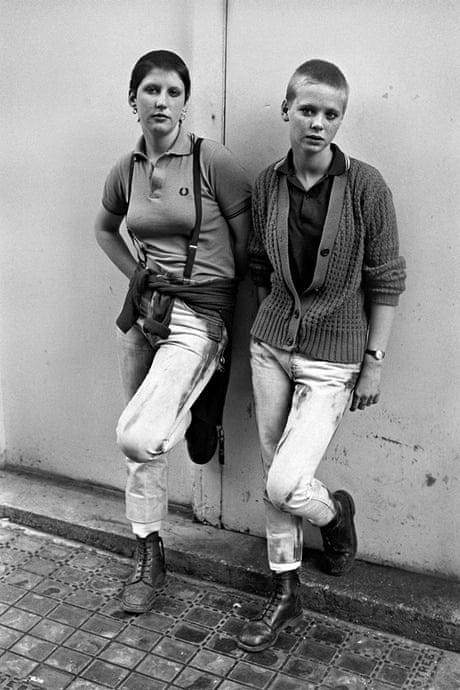
Madness had a considerable following from skinheads and those of their ilk notwithstanding the band’s well-known cultural inclusiveness. The heckling that developed shortly into Morrissey’s set came from all sides within the audience that day. As it happened, Morrissey utilized a backdrop composed of a photograph (ironically taken by an New Musical Express photographer in 1980) of two skinhead girls2 during his set.
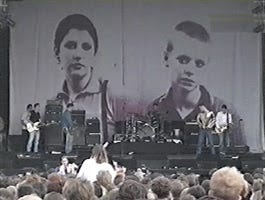
Morrissey then displayed a Union Jack during his performance of ‘Glamorous Glue’, at times wrapping himself in the flag.
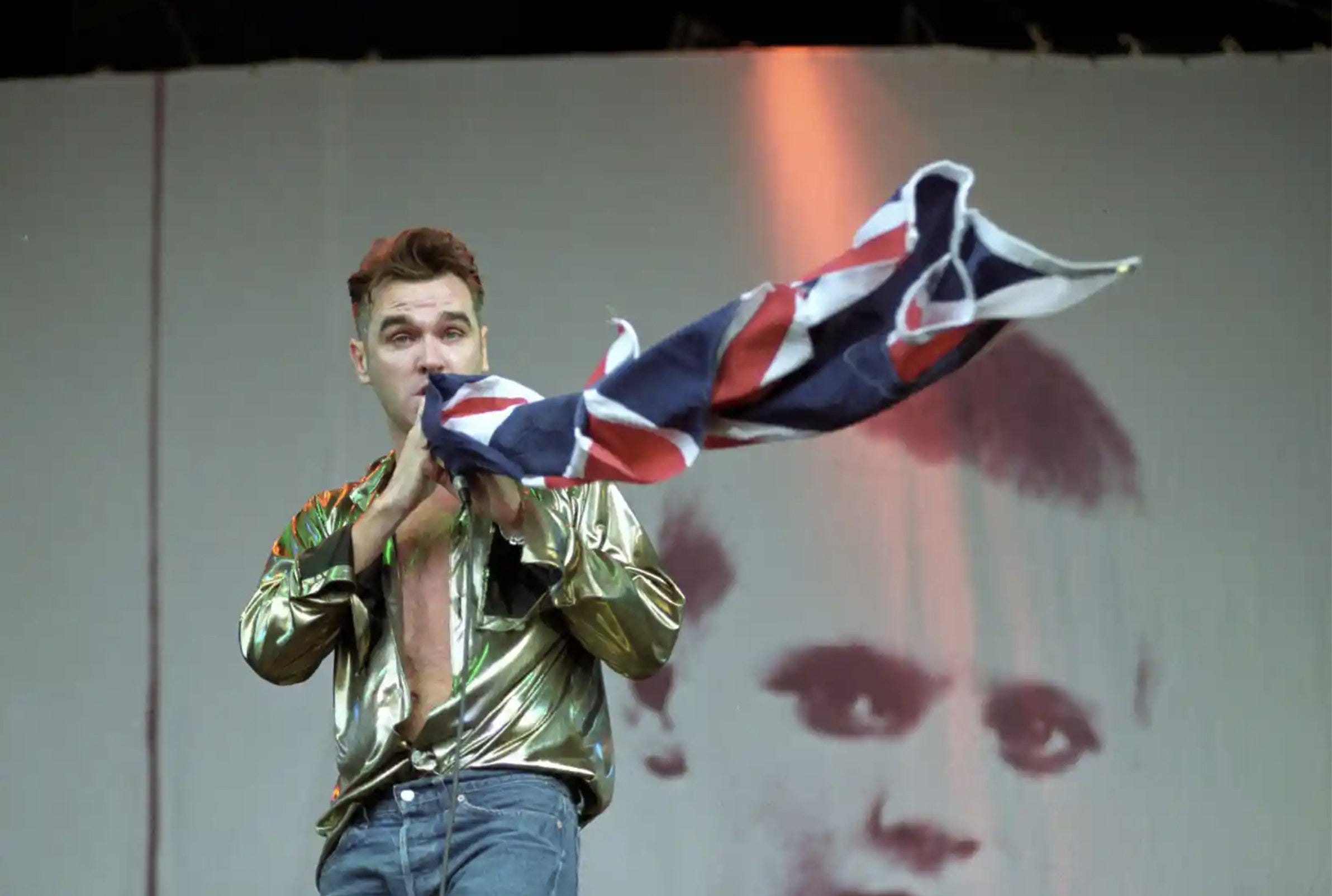
Morrissey’s temerity in displaying his nation’s flag seems to have inflamed certain members of the audience and press - apparently there was, and is, an unwritten prohibition against any display that may smack of patriotism (though this rule does not appear to apply to others). The mounting abuse as the set continued eventually forced Morrissey to walk out after only nine songs.
Morrissey withdrew from the 2nd night he was to appear at the festival, complaining about “the abysmal behavior of a small group of loathsome yobbos” (He later refined this to “a small selection of rather dull North Londoners”). When one considers that ‘Glamorous Glue’ is a lament for a disappearing British culture, it is ironic that fans of the most ‘London’ act at the time (Madness) would hurl objects and verbal abuse at Morrissey.
This so-called incident was widely reported in the UK music papers in something less than a flattering light, with the New Musical Express (“NME”) leading the charge in its issue later that month:
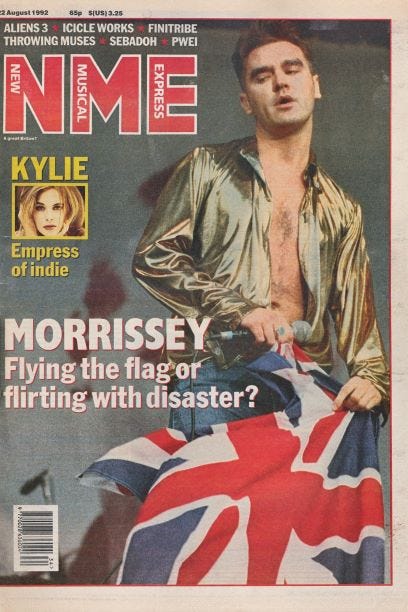
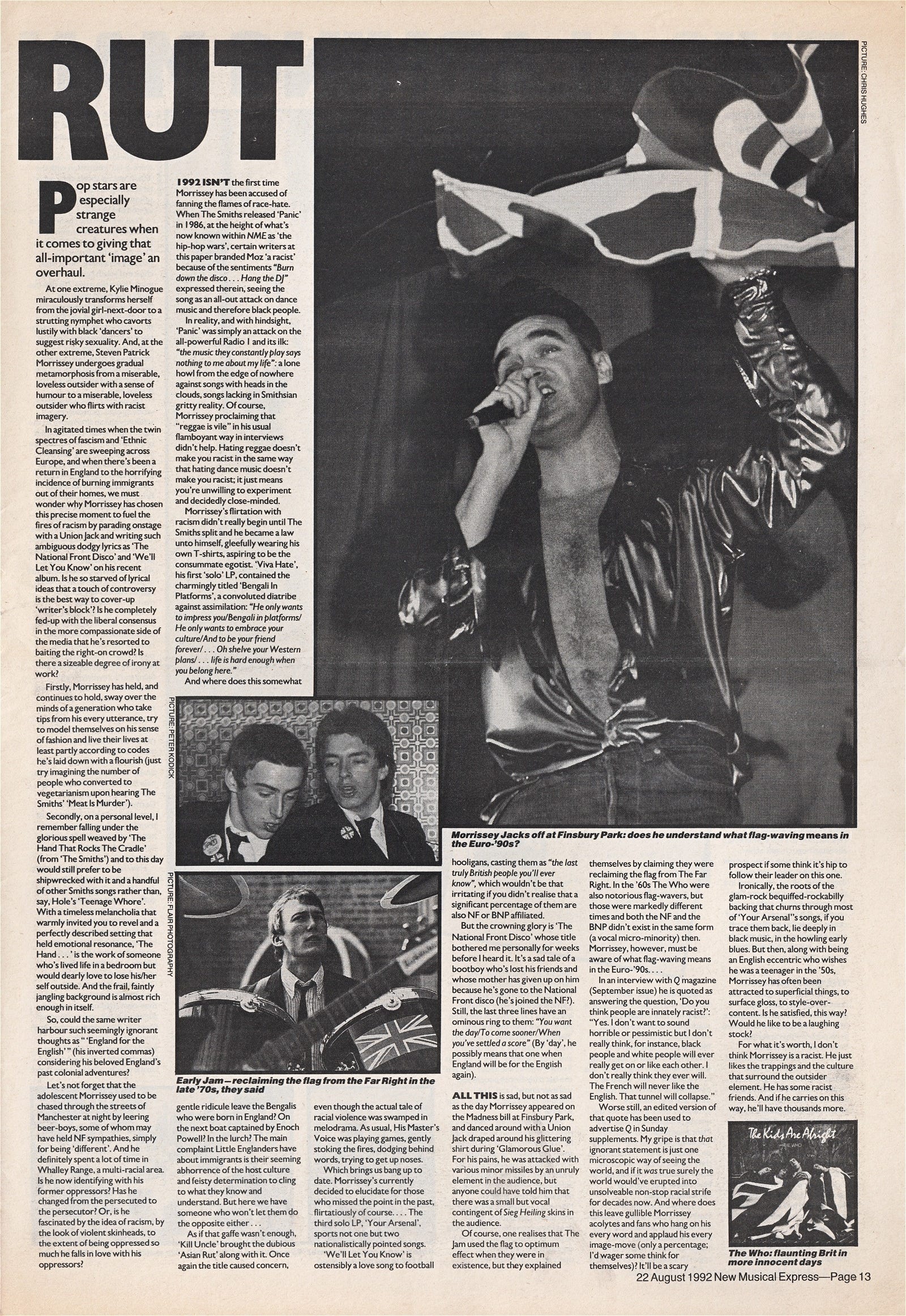
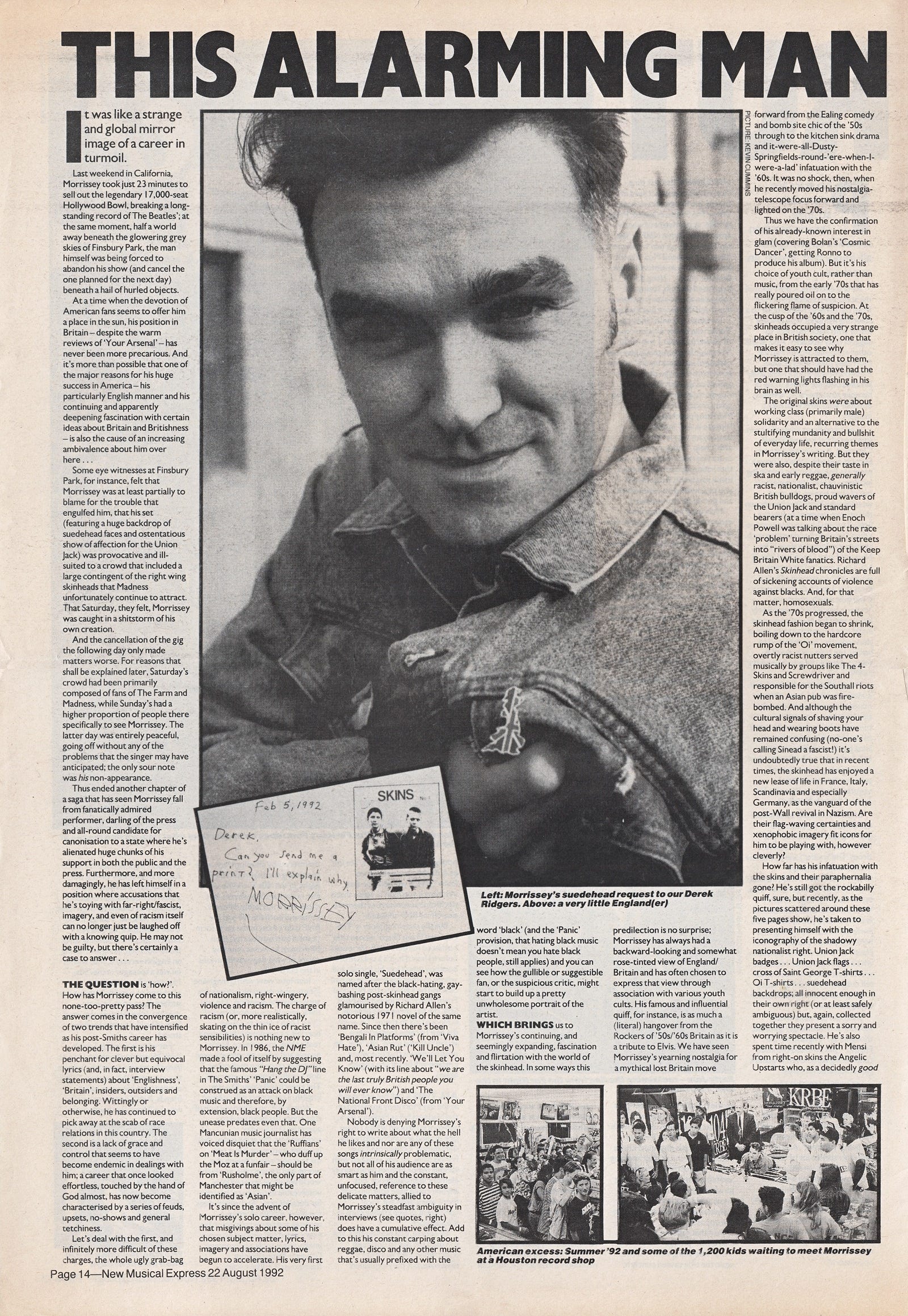
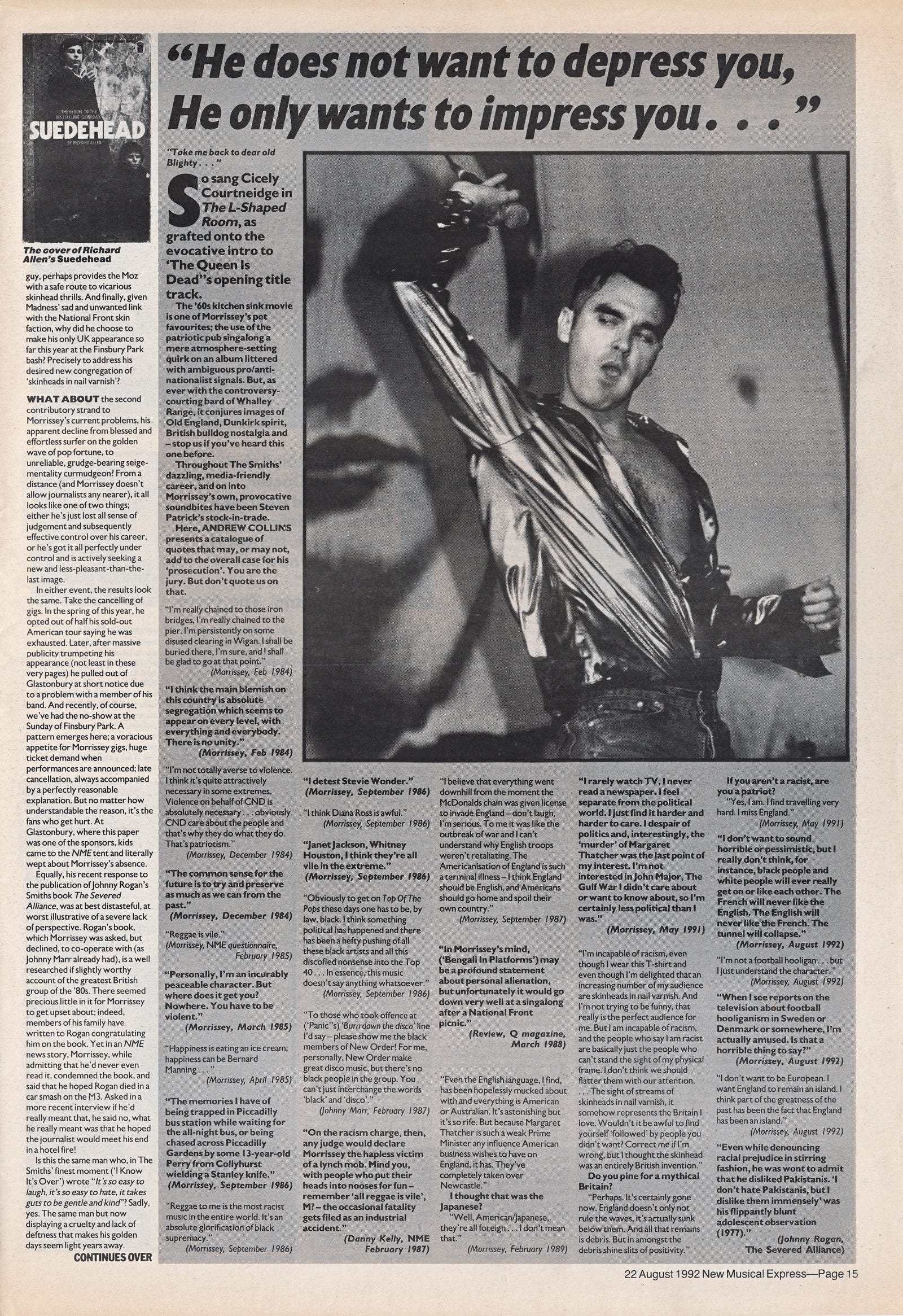
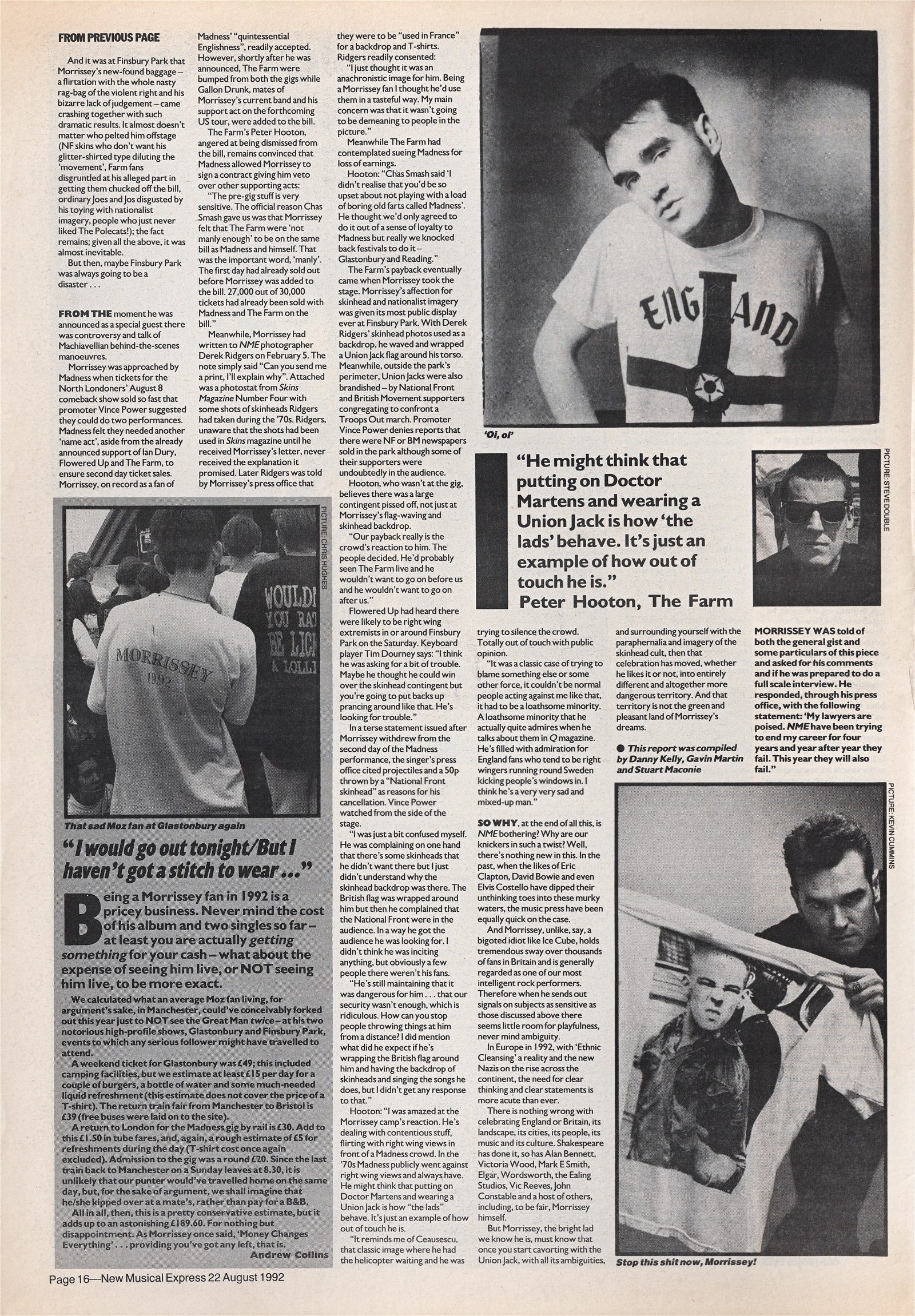
The juxtaposition of the Union Jack and backdrop of two skinhead girls provoked the NME into devoting its front cover and a staggering 6,000 words to the question of whether Morrissey had gone too far at Finsbury. Given that by 1992 the Union Jack was seen as deeply suspect in Leftish culture for some time (a perception that continues to this day), Morrissey’s display of the flag, even if it was meant merely as a sort of prop, conjured up images of the former British Empire, which is generally regarded as something quite bad in progressive circles. Indeed, by the 1990’s the Union Jack was perceived by some in the UK to be closely associated with domestic extreme-right groups.
Apparently, the NME found a fine line between patriotism and racism, as their article on Morrissey cited song lyrics and quotes from interviews, to show that he had long been “toying with far-Right/fascist imagery, and even of racism itself”, with his display of the dreaded Union Jack as the proverbial last straw. While the NME stopped short of calling Morrissey a racist, it concluded that “he has continued to pick away at the scab of race relations”.
As the saying goes, timing and perception are everything; it did not help that Morrissey was quoted in Q Magazine barely a month after the festival as saying that he didn't "really think, for instance, black people and white people will ever really get on or like each other. I don't really think they ever will." This comment - really an inconclusive observation - upset the sensibilities of some, and served to exacerbate the issue.
Whereas many artists would embark upon an apology tour of sorts in the wake of the NME’s petard, Morrissey did not bow to their criticism. Rather, he boycotted the magazine (who hitherto had been largely supportive of him) for 12 years. Morrissey only addressed the subject a few years later through a different publication.
Morrissey has refuted claims of racism leveled against him throughout the years. Indeed, in April 2019 Morrissey published an substantive interview conducted by his nephew, Sam Esty Rayner, on his website (Morrisseycentral.com) wherein he addresses this long-running issue at length:
Morrissey:
“…if you call someone racist in modern Britain you are telling them that you have run out of words. You are shutting the debate down and running off. The word is meaningless now. Everyone ultimately prefers their own race … does this make everyone racist? The people who reduce every conversation down to a matter of race could be said to be the most traditionally ‘racist’ because everything in life is NOT exclusively a question of race, so why make it so? Diversity can’t possibly be a strength if everyone has ideas that will never correspond. If borders are such terrible things then why did they ever exist in the first place? Borders bring order. I can’t see how opposing Halal slaughter makes me racist when I’ve objected to ALL forms of animal slaughter all of my life.”
Sam:
”The Guardian want to destroy you because you said you were not a member of the ‘Loony Left’. At this stage, anything you say they will turn into a global threat to humanity.”
Morrissey
”Yes, and it tends to spread … and suddenly The Independent reported how people are walking out of my concerts … which was a lie. It’s all very KKK, isn’t it? … share our views or we’ll smash your face in. But their level of determination reflects what they perceive to be your power and the weight of your views. If you were talking utter nonsense they wouldn’t bother with you. Inadvertently they are telling you that you matter enormously. My political stance is simple: I oppose barbarism … from the left from the right, or from the centre. You must finally wonder why The Guardian considers it their job to destroy ANYONE. It isn’t their job.”
Sam:
”But the problem for them is that you’ve said you are not left wing, and therefore they believe you ought not to exist.”
Morrissey:
”… which reflects their intolerance of diversity! It is not their place or their role in life to cut people down and attempt to wipe them out. They are not a political party, yet they think that they are.”
Sam:
”I don’t think people seriously believe that you are racist, but I think they enjoy saying that you are.”
Morrissey:
”Someone made the point the other day about David Bowie’s famous “England would benefit from a fascist government” comment … and his admiration for Hitler … and how Hitler was as stylish as Jagger … and how the UK needed a “complete right wing leader”. Could you imagine if I’d said THAT! Now, of course, I sat privately with David many times, and he wasn’t remotely fascist… although it has been said that he’d visited Hitler’s bunker. But, how many writers at The Guardian have David Bowie albums? All of them, probably! Hypocrisy? Obviously a fascist would never have recorded “Lady Stardust” … and a fascist would never have recorded “Wedding Bell Blues”, but, you see, the press choose their targets, and ignore what it suits them to ignore. In a way, that’s the key to modern Britain … only the mentally castrated are eligible for praise and awards. It’s against the law to be intelligent! The dumb have inherited the earth. Because of this, British arts are controlled by completely limited possibilities, and the same faces appear everywhere. When you start arguing with The Guardian you feel as if you’re trying to reason with people who are barely toilet-trained. There actually becomes no point.”
It is axiomatic that dogmatic ideology is resistant to reason and facts, and that it is absolutely at odds with free thinking and differing opinions, which it feels threatened by. One need to not look further than the fact that Morrissey was rabidly anti-Thatcher (‘Margaret on the Guillotine’), anti-monarchy (‘The Queen Is Dead’), and consumed with an uncompromising attitude towards animal rights (‘Meat Is Murder’) in the 1980’s to find holes in accusations since leveled by the UK music press and news media against him. Could it be that something else is afoot when Morrissey dares express an idea that doesn’t fit the accepted mold on the editorial floor of NME or the Guardian?
Precisely when did the media and others holding certain political/cultural views obtain an irrevocable monopoly upon what is true and good, as well as being the gatekeepers on what can (and cannot) be expressed in the public square? When exactly did the ability of an individual, whether a private citizen or a pop star, to engage in critical thinking and the exchange of ideas come to a sudden stop? Perhaps these questions need answering as ad hominem attacks and baseless accusations of racism do not add value to any discussion on the matter.
Indeed, if one were to arrive at any conclusions as to Morrissey’s mindset, it appears to be a safe assumption that it is a fairly progressive one. Otherwise, Morrissey must have been a fraud throughout the 1980’s or he somehow went through some manner of profound intellectual metamorphosis (perhaps some manner of mental breakdown?) since his time with the Smiths. Neither appears even remotely possible.
What seems to irk many people is Morrissey’s propensity to think independently - to observe, apprise, and then speak unapologetically, regardless of whether his opinion, whether in the form of answers to interview questions or the wording of a song lyric, is in line with “correct” thought. In this regard, Morrissey is who he is - guileless and wholly uncompromising in terms of expressing himself.
Inclusiveness, tolerance, and progressiveness are lovely sentiments, though they ring hollow when an individual is canceled and then turned into a virtual non-person by those who espouse them should one of their own not parrot what is approved thought. Indeed, history has shown time and again where such a path leads to at its inevitable conclusion. Perhaps the left should practice what it preaches, though such an indulgence may very well lead to it being exposed for what it is.
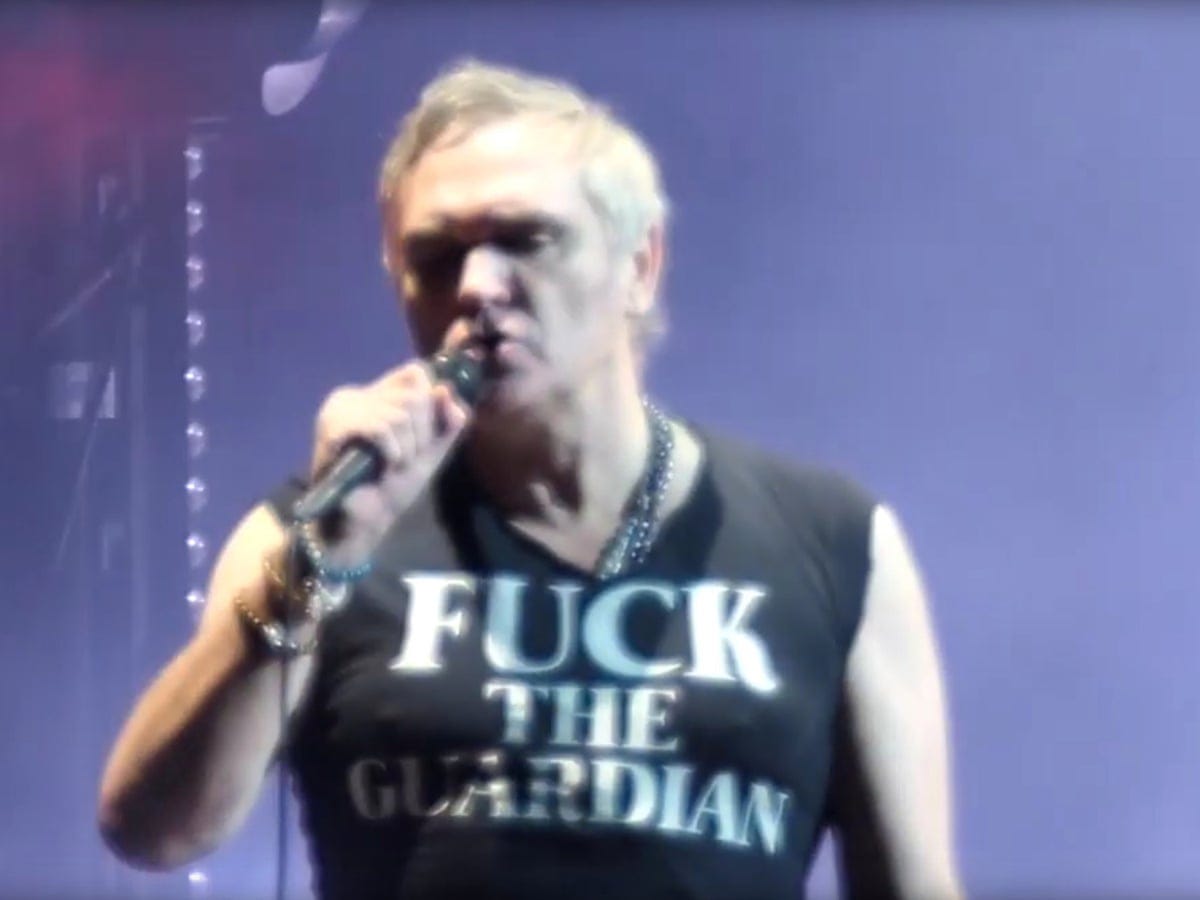
Watch a 1992 MTV special on Morrissey at the Madstock Festival here:
Madness are an English ska and pop band from Camden Town, north London, who formed in 1976.