
'Maladjusted'
"You do all that you do because it's all you can do"

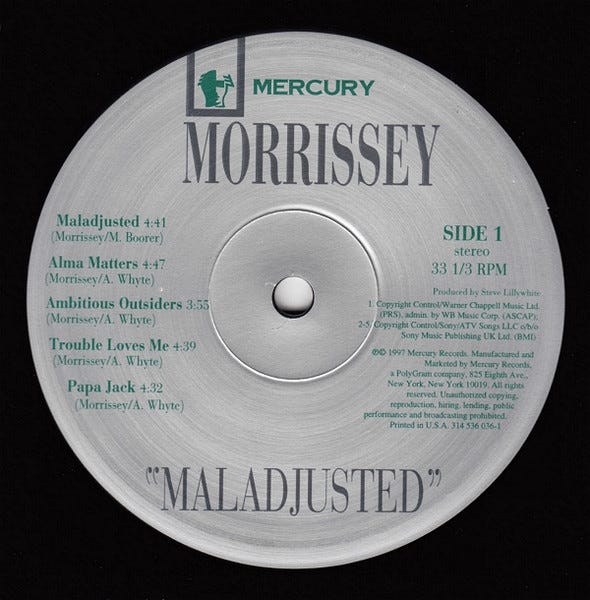
The title track from Morrissey's sixth studio album, the song 'Maladjusted' was likely written in 1996 or early 1997, with guitarist Boz Boorer composing the music. The song was recorded at Hook End Manor in January 1997 along with the rest of the tracks that appear on the studio album. Morrissey utilized Steve Lillywhite as producer, and musicians Alain Whyte (guitars, piano, backing vocals), Jonny Bridgwood (bass) and Spencer James Cobrin (drums) in addition to the aforementioned Boorer.
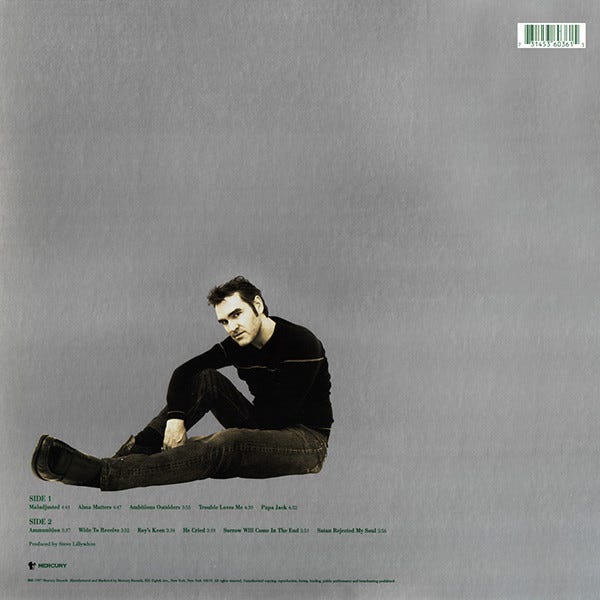
'Maladjusted' is marked by grittily distorted guitar and martial percussion while Morrissey relentlessly sings stream-of-consciousness style lyrics. It is one of those Morrissey songs that immediately catches ones attention - a discordant, evocative jewel emerges from the dust and the dirt - revealing a sort of raw honesty and clarity - not despite, but because it embraces the pathos of working-class youth in a manner that leaves the listener somewhat shaken.
One senses both dread and a hint of quiet desperation while Morrissey steadily disgorges a dissonant description of a youth marred by both deprivation and alienation.
The song is remarkable as while Morrissey at times sings about the troubled, almost desperate existence of an adolescent girl (“You stalk the house/In a low-cut blouse: ‘Oh Christ, another stifled Friday night!’”), he also sings directly from the girl’s perspective:
“Well, I was fifteen/Where could I go?/With a soul full of loathing/For stinging bureaucracy/Making it anything other than easy/For working girls like me”
This bleak setting is punctured by Morrissey almost defiantly stating that there is “nothing wrong with you” and “You do all that you do because it's all you can do”. Indeed, the song’s outro consists of the line “There's nothing wrong with you” being repeated over and again as if to underscore this point.
Listen to the remastered song from its 2009 reissue here:
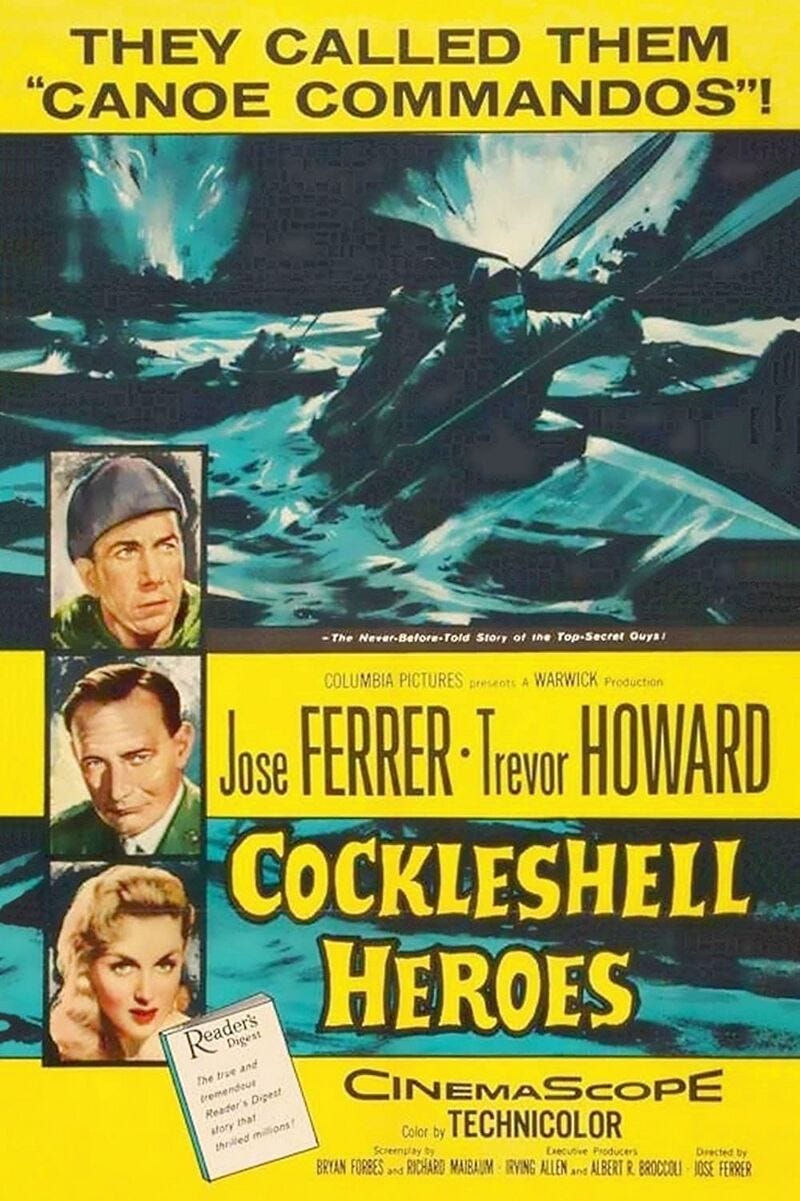
At the beginning of 'Maladjusted' there is a sample of actor Anthony Newley1 from the 1955 film The Cockleshell Heroes2: "On this glorious occasion of the splendid defeat". This is the second occasion that Morrissey sampled Anthony Newly (the first being a snippet of Newly as the Artful Dodger in the 1948 film Oliver Twist, which appears at the very end of 1994's 'Billy Budd'). Listen to the snippet from the film here:
Cockleshell_Heroes.mp3
On the matter of Morrissey having sampled dialogue from Cockleshell Heroes:
”Oh, it's just one of those crisp British films that you've probably seen at four o'clock on a rainy Sunday on a channel you never usually watch. It's actually not a very good movie although it is written by Bryan Forbes. It's just a masculine war movie where everyone's a marine soldier and everybody's happy all the time and every officer has a stiff upper lip. They go to war, to Bourdeaux, and return with a couple of limbs missing but they are still as jovial as ever. It's just one of those old films that gives us wonderful insight to merry old England.”
-Morrissey, POP magazine, 1998
This song has been performed in concert a total of 66 times by Morrissey. He sang it 20 times on the 1997 Maladjusted tour, as a regular for the first month, then only sporadically as the setlists featured less and less material from the album being promoted and more from the earlier Vauxhall & I and Southpaw Grammar albums. Against all expectations, the song was pulled out of the vaults and played every night on the second leg of the 2011 tour, for a total of 16 performances. It returned on and off the following year, played a total of 20 times out of 56 dates. It was last heard 10 times in 2013, out of 15 concerts given that year.3
Another version of ‘Maladjusted’ was recorded live on Y107's Modern Rock Live program in Los Angeles, California on August 16, 1997. The song begins at 0:30. Morrissey also performed four other songs from the Maladjusted studio album in this session.
On the subject of this song in the 2009 expanded and redesigned edition of the Maladjusted studio album, Morrissey wrote (in the media that accompanied the reissued album):
"Boz had written a risky tune with a dramatic outro. I ignore the risky tune and utilize only the outro, making it the entire recorded song. If Life is meaningless, then why did it ever begin? Michael Bracewell4 asks, 'are you mentioning Stevenage5 because you like Here We Go Round the Mulberry Bush so much?'6 and my answer is No. It is enough just to be."
(On this glorious occasion of the splendid defeat)
I wanna start from before the beginning
Loot wine:
"Be mine, and
Then let's stay out for the night"
Ride via Parkside
Semi-perilous lives
Jeer the lights in the windows
Of all safe and stable homes
(But wondering then, well,
What could peace of mind be like?)
Anyway, do you want to hear our story, or not?
As the Fulham Road lights
Stretch and invite into the night
From a Stevenage overspill
We'd kill to live around
SW6 - with someone like you
Keep thieves' hours with someone like you
...As long as it slides
You stalk the house
In a low-cut blouse:
"Oh Christ, another stifled
Friday night!"
And the Fulham Road lights
Stretch and invite into the night
Well, I was fifteen
What could I know?
When the gulf between
All the things I need and the things I receive
Is an ancient ocean wide - wild, lost, uncrossed
Still I maintain there's nothing wrong with you
You do all that you do because it's all you can do
Well, I was fifteen
Where could I go?
With a soul full of loathing
For stinging bureaucracy
Making it anything other than easy
For working girls like me
With my hands on my head
I'll flop on your bed
With a head full of dread
For all I've ever said
Maladjusted, maladjusted
Maladjusted, maladjusted
Never to be trusted
Oh, never to be trusted
There's nothing wrong with you
There's nothing wrong with you
There's nothing wrong with you
There's nothing wrong with you
There's nothing wrong with you
Anthony Newley (1931 – 1999) was an English actor, singer, songwriter, and filmmaker. He achieved widespread success in song, and on stage and screen. From 1959 to 1962 he scored a dozen entries on the UK Top 40 chart, including two number one hits. Newley won the 1963 Grammy Award for Song of the Year for "What Kind of Fool Am I?", sung by Sammy Davis Jr., and wrote "Feeling Good", which became a signature hit for Nina Simone. His songs have been sung by a wide variety of singers including Fiona Apple, Tony Bennett, Barbra Streisand, Michael Bublé and Mariah Carey.
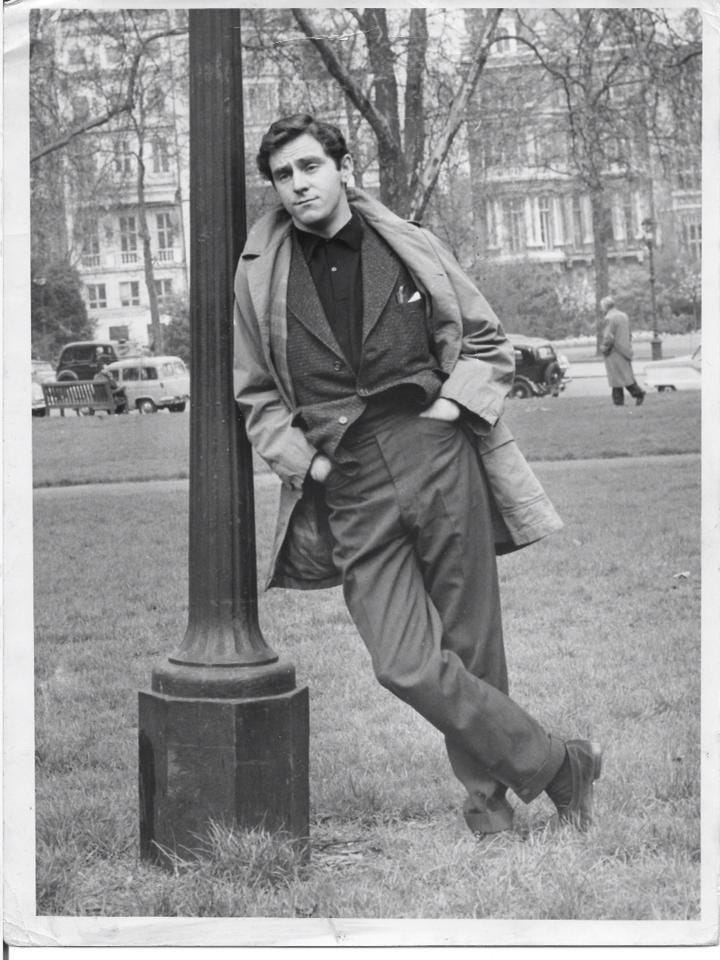
With songwriting partner Leslie Bricusse, Newley was nominated for an Academy Award for the film score of Willy Wonka & the Chocolate Factory (1971), featuring "Pure Imagination", which has been recorded by dozens of singers. He collaborated with John Barry on the title song for the James Bond film Goldfinger (1964), sung by Shirley Bassey.
Described by The Guinness Book of British Hit Singles & Albums as "among the most innovative UK acts of the early rock years before moving into musicals and cabaret", Newley was inducted into the Songwriters Hall of Fame in 1989.
Aside from the film dialogue snippets referenced in this post, Morrissey also used Anthony Newley’s image as a concert backdrop beginning in 2023.
The Cockleshell Heroes is a 1955 British war film with Trevor Howard, Anthony Newley, Christopher Lee, David Lodge and José Ferrer, who also directed. The film depicts a heavily fictionalized version of Operation Frankton, the December 1942 raid on German cargo shipping by British Royal Marines Commandos, who infiltrated Bordeaux Harbor using folding kayaks. It was the first Warwick Film to be filmed in CinemaScope. The producer, Cubby Broccoli, went on to produce films about a famous fictional commander of the Royal Navy in the James Bond franchise. While it was released in late 1955, The Cockleshell Heroes was one of the top British box office hits of the following year.
Stephane at PassionsJustLikeMine.com
Michael Bracewell (born August 7, 1958) is a British writer and novelist. He was born in London, and educated at the University of Nottingham, graduating in English and American Studies.

Stevenage is a town in Hertfordshire, England, about 27 miles (43 km) north of London. In 1946, Stevenage was designated the United Kingdom's first New Town under the New Towns Act. In keeping with the sociological outlook of the day in post-war Britain, the town was planned with six self-contained neighborhoods. Watch this 1965 documentary about the town:
The town of Stevenage was the setting for Here We Go Round the Mulberry Bush, a 1968 British comedy produced and directed by Clive Donner.
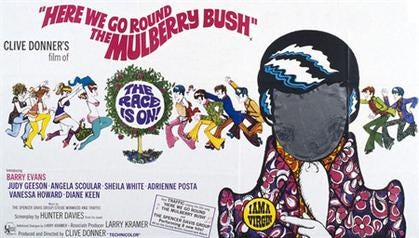
Watch a delightful snippet of Here We Go Round the Mulberry Bush here:
This song is brilliant. It would make a great spoken word piece. I'm currently listening to this album to go to sleep to. 😴 🥰