
"Mexico"
Morrissey's Elegy for a World Already Lost

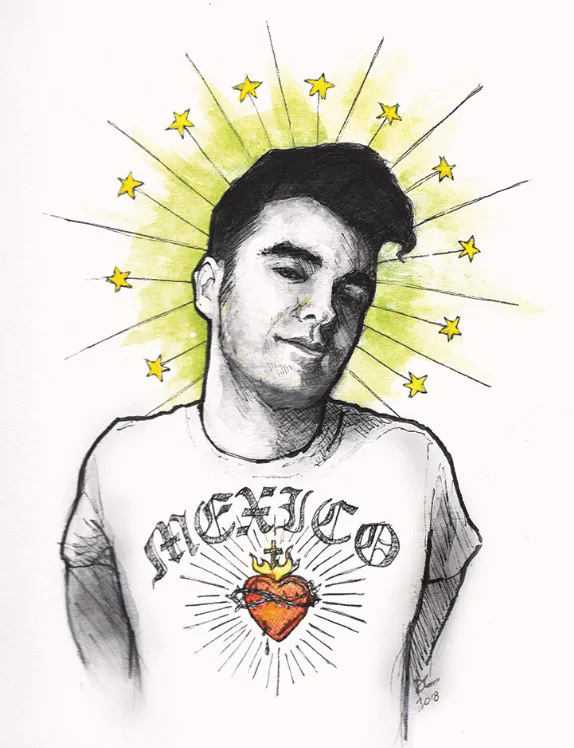
Co-written with Boz Boorer and Gary Day, “Mexico” is generally thought to date from the period between 2000 and its live debut in August 20021, though its precise recording history remains uncertain. Despite the credits on the single on which the song was released citing Los Angeles, it may in fact have been recorded alongside material for You Are the Quarry at Sarm Hook End in England in the autumn of 20032. There is also a possibility that the track predates the You Are the Quarry sessions altogether, leaving its exact place in Morrissey’s recording chronology unresolved.3 “Mexico” was produced by Jerry Finn, with Boz Boorer and Alain Whyte on guitars, Gary Day on bass, Dean Butterworth on drums. and Mikey V. Farrell on keyboards.
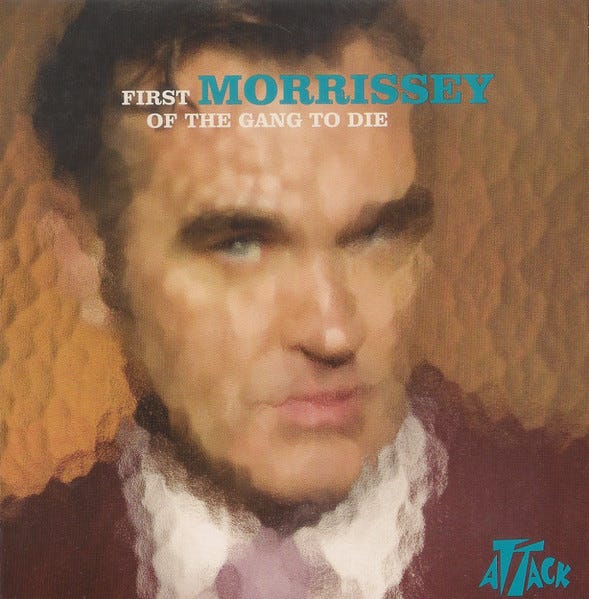
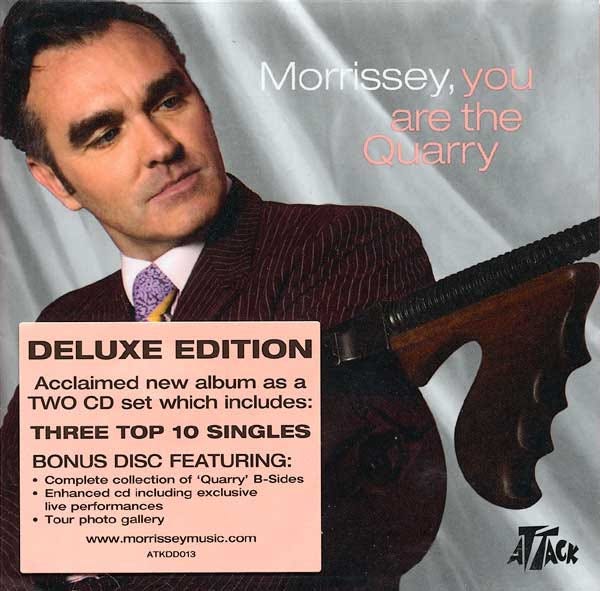
The song appeared as a B-side to the U.S. and European releases of the “First of the Gang to Die” single, Morrissey’s 28th single, in July 2004. It was also included on the deluxe edition of You Are the Quarry, issued in November 2004.
The song’s title is most certainly a tribute to Mexico as a place and, by extension, to its people. Notwithstanding this, careful scrutiny indicates that its lyrics function less as a meditation on the title than as an indictment of America’s cultural, political, and moral sprawl4. Mexico operates not as a literal place but as an abstract sanctuary, an imagined elsewhere where Morrissey can momentarily exist without his emotional and existential armor. Lines such as “I went for a walk to inhale / the tranquil, cool, lover’s air” and “I lay on the grass / and cried my heart out / for want of my love” evoke a pastoral, almost Edenic fantasy: a refuge defined by emotional openness rather than geography. This illusion is belied by the intrusion of “American chemical waste” and “the hate from the Lone Star State,” suggesting that American hegemony seeps beyond borders, poisoning even the idea of an idyllic haven.
The blunt refrain about being “rich and white” underscores not simply privilege, but the moral certainty that accompanies power, a confidence so pervasive it renders resistance futile. The recurring question, “What can we do?”, is not a call to action but an admission of impotence. In the end, Mexico remains unreachable, perhaps never real at all, and the song circles back on itself, leaving Morrissey stranded between longing and resignation, mourning not just a lost love, but the impossibility of any untouched refuge in a world dominated by American certainty.
It is no coincidence that Morrissey chose Mexico of all places to serve as an abstract sanctuary. Mexico is a country whose devotion to Morrissey is among the most profound anywhere in the world, very likely exceeding that of his audiences anywhere else.
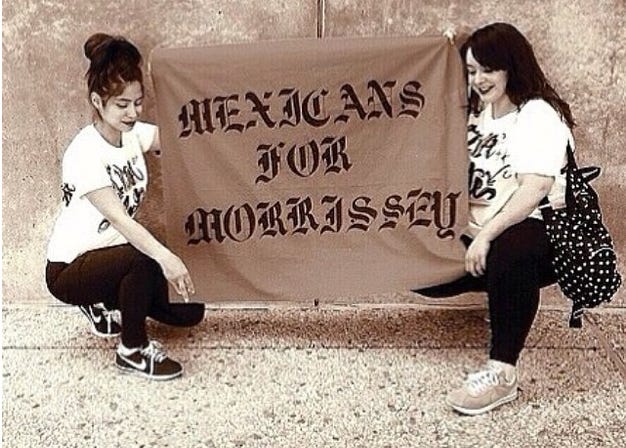
Mexican fans have long demonstrated a special attachment that extends beyond the music itself to the man and the words he sings. In turn, Morrissey has repeatedly acknowledged a deep and enduring bond with Mexico5 and its fans. “Mexico” can be read as an act of affectionate reciprocity: a song offered to the people of Mexico in recognition of their loyalty, respect, and shared emotional understanding.

The affinity between Mexico and a singer from Manchester, England, is certainly curious on its face, though a deeper examination reveals a connection that is extraordinarily profound.
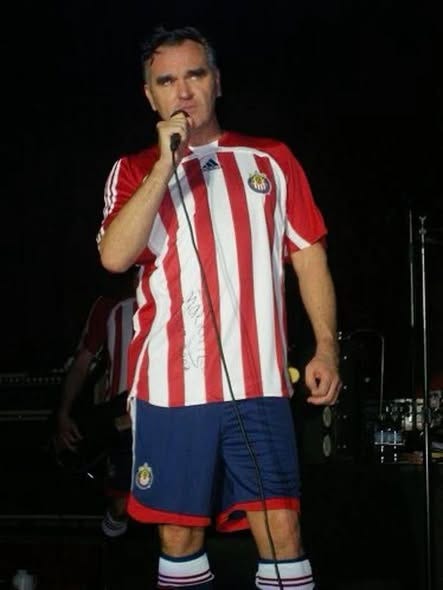
Mexico’s musical tradition is deeply rooted in ranchera and mariachi, styles dominated by songs of love, loss, and sorrow. These themes closely mirror the lived experiences of the Mexican people. Against this backdrop, Morrissey’s lyrics, so often immersed in loneliness and emotional suffering, resonate with particular force. His vocal delivery, intensely expressive and unmistakably personal, has frequently been compared to the emotive tradition of ranchera singing, a style so raw and heartfelt that it is famously capable of reducing even the most stoic listener to tears.
There is also a powerful religious and cultural alignment. In a society deeply shaped by Catholicism and closely attuned to the suffering of Christ, Morrissey’s recurring lyrical references to Jesus foster a sense of intimacy and recognition among Mexican listeners. Added to this are subtler parallels of identity and style. Morrissey’s background, marked by marginalization, class consciousness, and Catholic heritage, echoes familiar social hierarchies long understood in Mexico. His post-Smiths embrace of 1950s rockabilly aesthetics and outsider posturing, while not identical, finds parallels in earlier Mexican subcultures such as pachucos and greasers6. Taken together, these emotional, spiritual, and cultural correspondences help explain why Morrissey’s music has found such deep and lasting meaning in Mexico.
Subdued, sparse, and mildly melancholic, the music of “Mexico” possesses an elegiac atmosphere. Morrissey’s vocal delivery is intimate and almost confessional in style, as he wearily makes his way through the lyrics, evoking a sense of quiet mourning as he sings of an emotive refuge that remains out of reach. In the end, Morrissey grieves not so much for a place as for the loss of hope that sanctuary might exist anywhere, even in his imagination.
At the opening show of Morrissey’s World Tour 2002, held on 9 August 2002 at Celebrity Theatre in Phoenix, Arizona on 9 August 2002.
According to Stéphane (Passions Just Like Mine), the recording sessions for You Are the Quarry, while formally credited to Los Angeles, were actually split between Sarm Hook End in in England during the autumn of 2003 and Conway Studios in Los Angeles, California in late 2003 or early 2004.
Stéphane, “Mexico,” Passions Just Like Mine, http://www.passionsjustlikemine.com/songs/songs-mexico.htm.
Morrissey explores this theme in “America Is Not The World”, the opening track on 2004’s You Are The Quarry studio album. “America Is Not The World” finds Morrissey condemning America’s bloated power, moral hypocrisy, and cultural arrogance while simultaneously expressing a wounded but sincere love for it.
During his 1999 ¡Oye, Estéban! tour, Morrissey frequently led audiences into chants of “Mexico! Mexico! Mexico!” at concerts in California and Las Vegas, Nevada. At one California performance, he told a largely Mexican-American crowd, “I wish I was born Mexican, but it’s too late for that now.” Morrissey is also quoted as saying that “nothing the world holds could match the love waiting for me in Mexico City.”
While largely found within Chicano communities in the United States, these subcultures also had a presence in Mexico proper.