
The Queen is Dead
The Smiths savage, scathing, and hilarious title track from their third studio album

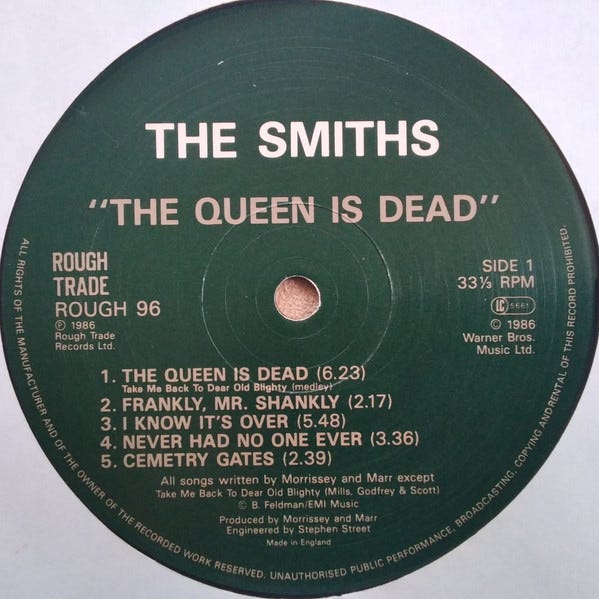
The opening track on the Smiths’ third studio album of the same name, the story of the Smiths' song, 'The Queen Is Dead', actually begins with a live performance of the band's 1985 song 'Barbarism Begins at Home', where Morrissey ad-libbed the lyrics "the queen is dead", which is a phrase from the 1964 novel Last Exit to Brooklyn. This utterance apparently inspired Morrissey to write a new song around this politically-tinged phrase. However, Johnny Marr is of a different opinion as to Morrissey's inspiration for the song:
Record Collector: "The title track of The Queen Is Dead was obviously influenced by the Stooges and the MC5."
Marr: "Yes, I just traced it back. It was Morrissey's idea to include 'Take Me Back To Dear Old Blighty' and he said, 'I want this on the track'. But he wasn't to know that I was going to lead into the feedback and drum rolls. It was just a piece of magic. I got the drum riff going and Andy got the bass line, which was one of his best ever and one that bass players still haven't matched. I went in there with all the lads watching and did the take and they just went, 'Wow'. I came out and I was shaking. When I suggested doing it again, they just said, 'No way! No way!' What happened with the feedback was I was setting my guitar up for the track and I put it onto a stand and it was really loud. Where it hit the stand, it made that note of feedback. I did the guitar track, put the guitar on the stand, and while we were talking, it was like, 'Wow, that sounded good'. So I said, 'Right - record that!' It was going through a wah-wah from the previous take, so I just started moving the wah-wah and it was getting all these different intervals, and it definitely added a real tension. I loved Morrissey's singing on that, and the words. But it was very MC5. Morrissey has a real love for that music as well. I remember him playing the Ramones as much as he played Sandie Shaw."1
Johnny Marr's music for the song appears to have been influenced by the Velvet Underground's song "I Can't Stand It",* which had been unreleased by the band until it appeared on an archival compilation in 1985. Marr has said that "For the frenzied wah-wah section on 'The Queen Is Dead,' I was thinking '60s Detroit, like the MC5 and the Stooges."* Marr has also stated that his musical composition is "...as good if not better than anything the Stooges ever did. It's got energy and aggression in that kind of garagey way."2
Listen to "I Can't Stand It" by the Velvet Underground here:
According to Andy Rourke, much of the song's composition resulted from extensive jamming in the studio:
"Sometimes you can go into the studio and you can play for a whole day and nothing will happen. That day magic happened and we came up with this amazing song that became the theme of the whole album."3
Rourke composed the song's bassline in the studio, a performance Marr described as an accomplishment "that [other] bass players still haven't matched". Upon Rourke's death in 2023, Marr added: "Watching him play bass on the song 'The Queen is Dead' was so impressive that I said to myself 'I'll never forget this moment.'"
Marr also developed his guitar line in the studio, manipulating the note of a harmonic with the angle of his wah-wah pedal. As Marr later explained:
"I'd done the rhythm track for The Queen Is Dead, and left the guitar on the stand. The wah pedal just happened to be half open, and putting the guitar down made the guitar suddenly hit off this harmonic. We were back at the desk playing back the rhythm track and I could still hear this harmonic wailing away, so we put the tape back onto record while I crept back into the booth and started opening up the wah-wah, thinking 'Don't die, don't die!' Eventually I opened up the pedal, and 'Wooooohhhhhh!' Kept it going, too. Great accident..."4
Mike Joyce's layered drum intro was the result of a looped sample that Joyce recorded. According to the band's engineer Stephen Street, "We had this very antiquated sampler ... you could only record for so long but you could loop it. We got Mike to play this rumbling rhythm and then sampled a small section of it."
The Smiths recorded 'The Queen Is Dead' at Jacobs Studios in Farnham (Surrey) in October-November 1985, alongside most of the material that would become the album The Queen Is Dead studio album. Morrissey and Marr produced the recording, with Stephen Street acting as recording engineer. The original recording extended to over seven and one-half minutes. At the suggestion of Street, about a minute of the song was cut from the final recording. Originally, the band had planned for the song to fade out.
'The Queen is Dead' deals with Morrissey's well-known disdain for the monarchy, which he has since described as an "unequal and inequitable social system. There is no such thing as a royal person. You either buy into the silliness or else you are intelligent enough to realize that it is all human greed and arrogance."5 In an interview at about the time of the album's release, Morrissey explained, "I didn't want to attack the monarchy in a sort of beer monster way but I find as time goes by this happiness we had slowly slips away and is replaced by something that is wholly grey and wholly saddening. The very idea of the monarchy and the Queen of England is being reinforced and made to seem more useful than it really is."6
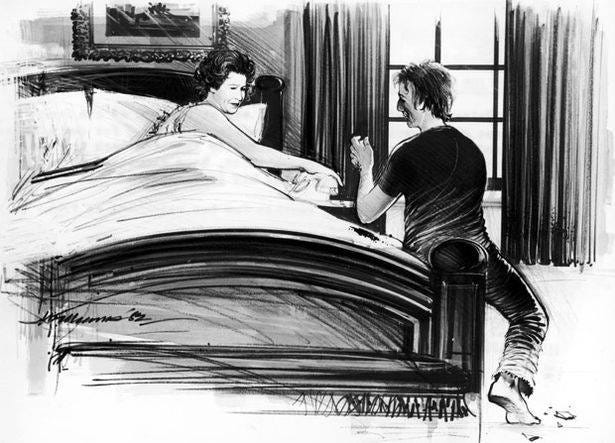
Morrissey makes camp references in the song, punning on the double meaning of queen: as he noted in the press, "There's a safety net in the song that the 'old queen' is me". Morrissey also drew upon Michael Fagan's7 infamous trespassing incident for lyrical inspiration, with the song's third verse contains a direct reference to it:
"So I broke into the Palace / With a sponge and a rusty spanner / She said: "Eh, I know you, and you cannot sing" / I said: "That's nothing - you should hear me play piano"
Per Morrissey's request, the song begins with a snippet of ‘Take Me Back to Dear Old Blighty’, sung by actress Cicely Courtneidge in the 1962 film The L-Shaped Room. This film is considered part of the 'kitchen sink' realism school of British drama, and is an apparent favorite of Morrissey. ‘Take Me Back to Dear Old Blighty’ is a music hall song written by Arthur J. Mills, Fred Godfrey and Bennett Scott in 1916. It was popular during the First World War, telling a story of three fictional soldiers on the Western Front suffering from homesickness and their longing to return to "Blighty" - a slang term for Britain.
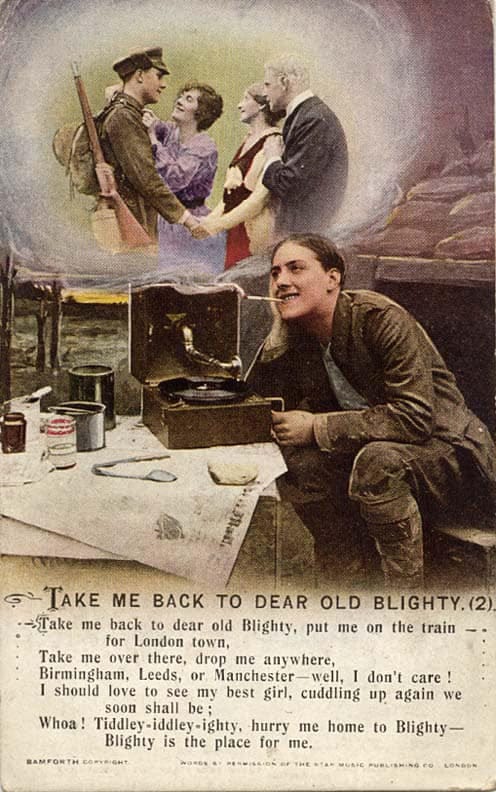
The scene from The L-Shaped Room containing the full rendition of ‘Take Me Back To Dear Old Blighty’ can be seen here:
The Queen Is Dead studio album was released in June 1986 to much acclaim. Whether or not the Smiths should have released ‘The Queen Is Dead’ as a single is open to debate, though one can reasonably surmise that it would have elicited considerable excitement if it had been in place of ‘Big Mouth Strikes Again’ (the album’s 6th track, which was released as a single on May 19, 1986, about a month prior to the album release). Nevertheless, ‘The Queen Is Dead’ was utilized for a striking and innovative music video directed by Derek Jarman:
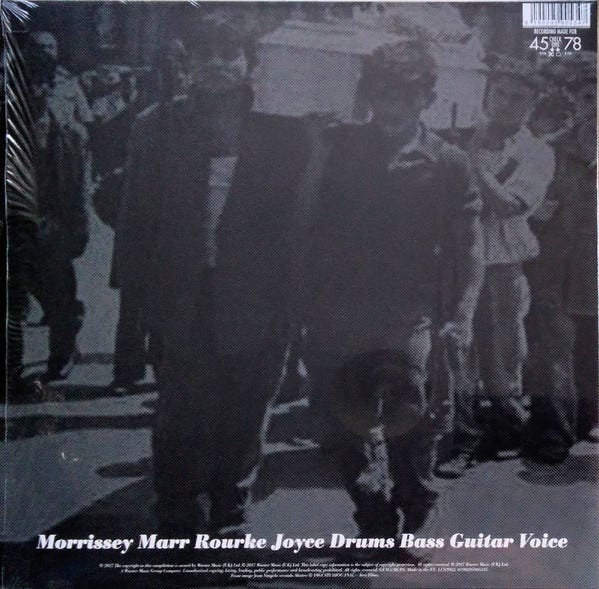
Nearly three decades after the dissolution of the Smiths, 'The Queen Is Dead' was released as a single in June 2017. It is the Smiths’ 28th (and, as of the date of this post, their last) single. The 'Take Me Back to Dear Old Blighty' medley that is present at the beginning of the 1986 studio album version of the song is omitted on the 2017 single. The B-side of the single contains the Smiths' only instrumental tracks - 'Oscillate Wildly', 'Money Changes Everything', and 'The Draize Train' - which had never previously been compiled for release on one single unit.
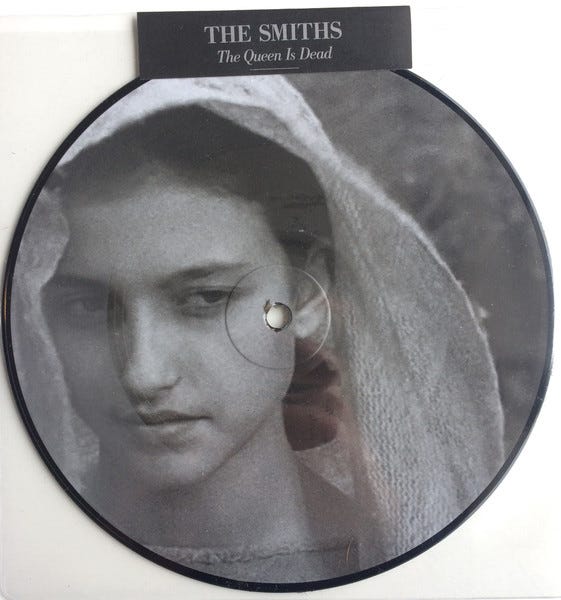
In addition to 7 and 12-inch vinyl formats, a 7-inch picture disc version of the song was also released, but with 'I Keep Mine Hidden' on the B-side.
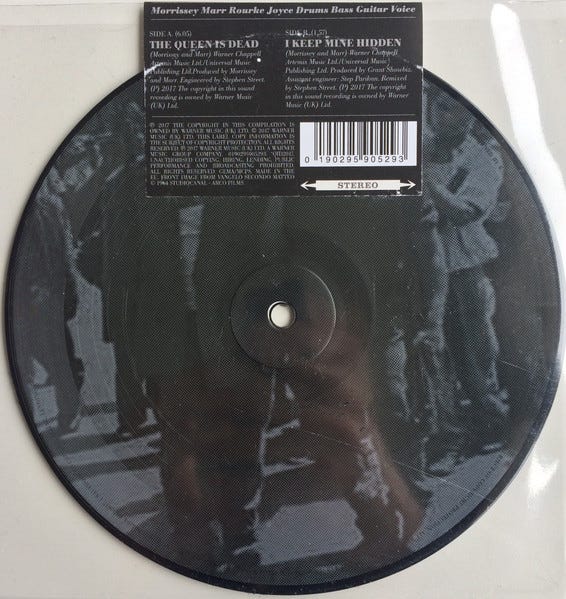
This was the 2nd time that 'I Keep Mine Hidden' appeared as a Smiths single B-side (the first time being 1987's 'Stop Me If You Think You've Heard This One Before' single).
The single was sold exclusively at brick & mortar shops. The UK music and entertainment retailer HMV limited the number of records sold to one per person, which resulted in Morrissey accusing them of trying to "freeze sales" on the new single.
The cover art for the 2017 single consists of a photo still of Margherita Caruso in her role of Mary (mother of Jesus) in the 1964 film 'Il vangelo secondo Matteo'.
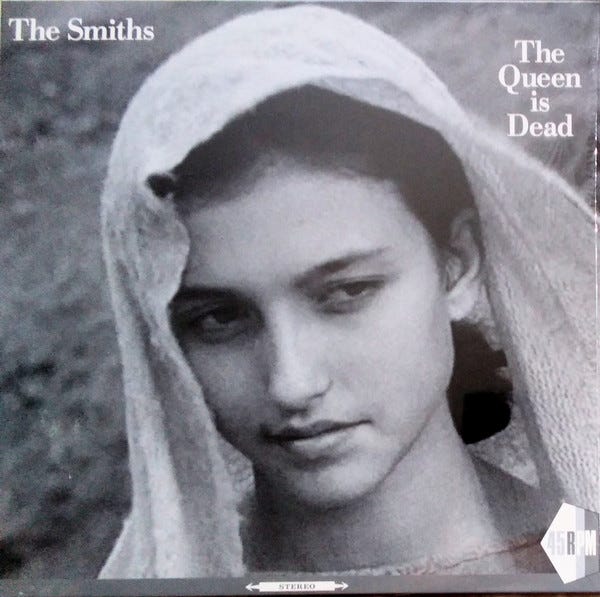
The film is a biblical drama in the Italian neorealist style, written and directed by Pier Paolo Pasolini. It is a cinematic rendition of the story of Jesus according to the Gospel of Matthew, from the Nativity through the Resurrection. In 2015, the Vatican City newspaper 'L'Osservatore Romano' called it the best film on Christ ever made.
Johnny Marr, Record Collector, November/December 1992
Johnny Marr, Guitar Player, January 1990
Tony Fletcher, A Light That Never Goes Out: The Enduring Saga of the Smiths, 2013
Johnny Marr, The Guitar Magazine, January 1997
News Corp Australia Network, August 3, 2016
New Musical Express, June 7, 1986
Michael Fagan was born in London on August 8, 1948, the son of Ivy and Michael Fagan Sr. His father was a steel erector and (allegedly) a "champion" safe-breaker. He left home In 1966 to escape his father who, Fagan says, was violent. He started working as a painter and decorator. In 1972, he married Christine, with whom he had four children. While his wife left him the same year of the break-ins, she later reunited with Fagan.

In early July 1982, Fagan intruded into Buckingham Palace. He stated that he shimmied up a drainpipe and startled a housemaid, who called security. He disappeared before the guards arrived, who then disbelieved the housemaid's report. Fagan said he then entered the palace through an unlocked window on the roof and wandered around for the next half-hour while eating cheese and crackers. Three alarms in total were tripped, but the police turned them off, believing they were faulty. He viewed royal portraits and sat for some time on a throne. He also spoke of entering the post room. He drank a half bottle of white wine, became tired and left.
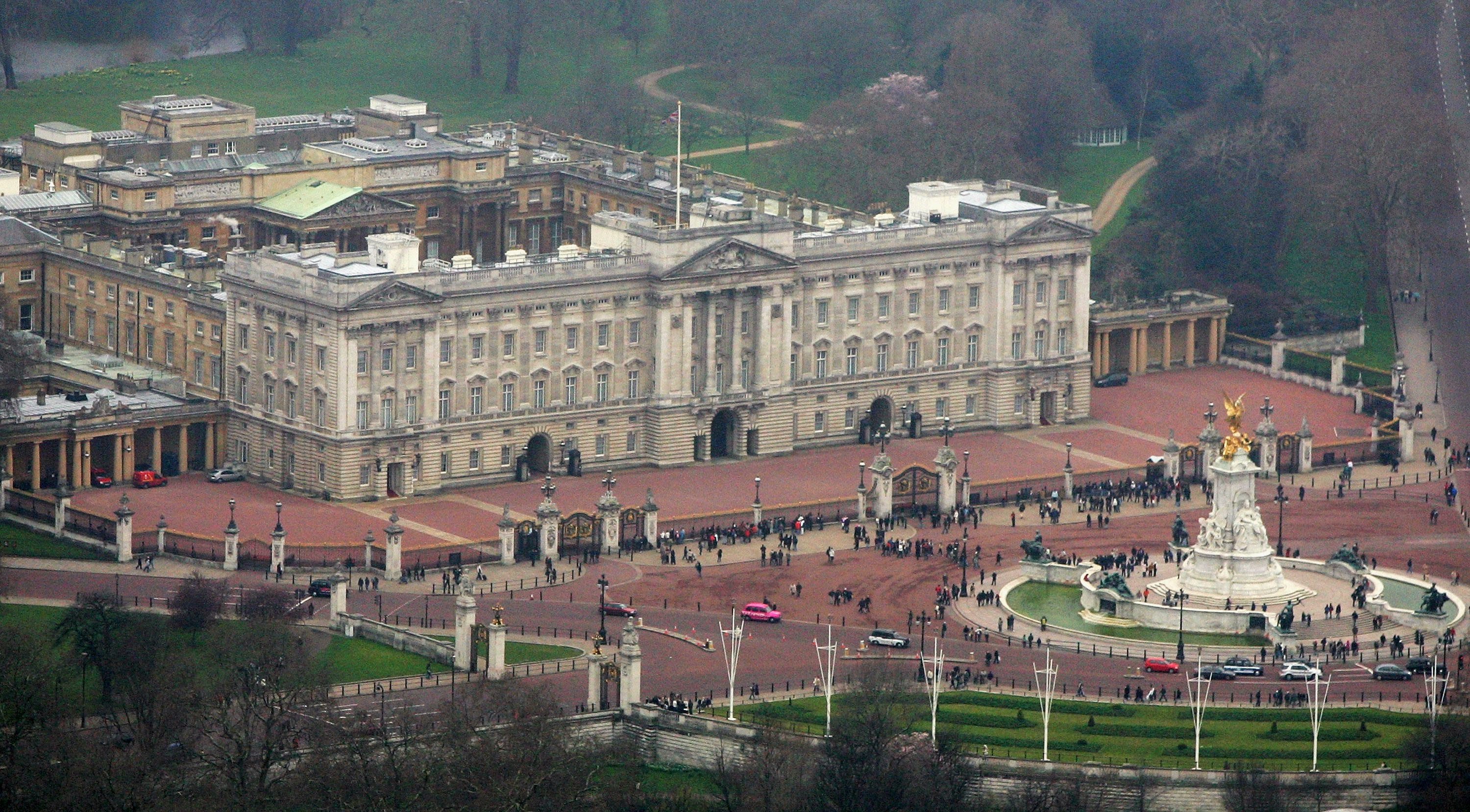
At around 7:00 a.m. on July 9, 1982, Fagan scaled Buckingham Palace's 14-foot-high perimeter wall, which was topped with revolving spikes and barbed wire, and climbed up a drainpipe. An alarm sensor detected his movements, but as was the case with his initial entry, the police believed the alarm to be faulty and simply silenced it! Once inside the palace, Fagan wandered the corridors for several minutes before reaching the royal apartments. In an anteroom, Fagan broke a glass ashtray, cutting his hand. He then entered the bedroom of Queen Elizabeth II at about 7:15 am carrying a fragment of glass.
The Queen woke when Fagan disturbed a curtain. Initial reports said he had sat on the edge of her bed and that they had a long conversation; however, Fagan described a decidedly brief exchange when interviewed* about the incident many years later:
"I was scareder than I'd ever been in my life," he says, widening his eyes theatrically as he recalls the moment he pulled back the curtains to see the Queen staring up at him. "It was a double bed but a single room, definitely – she was sleeping in there on her own," he giggles. "Her nightie was one of those Liberty prints and it was down to her knees. Then she speaks and it's like the finest glass you can imagine breaking: 'Wawrt are you doing here?!' She went past me and ran out of the room; her little bare feet running across the floor."
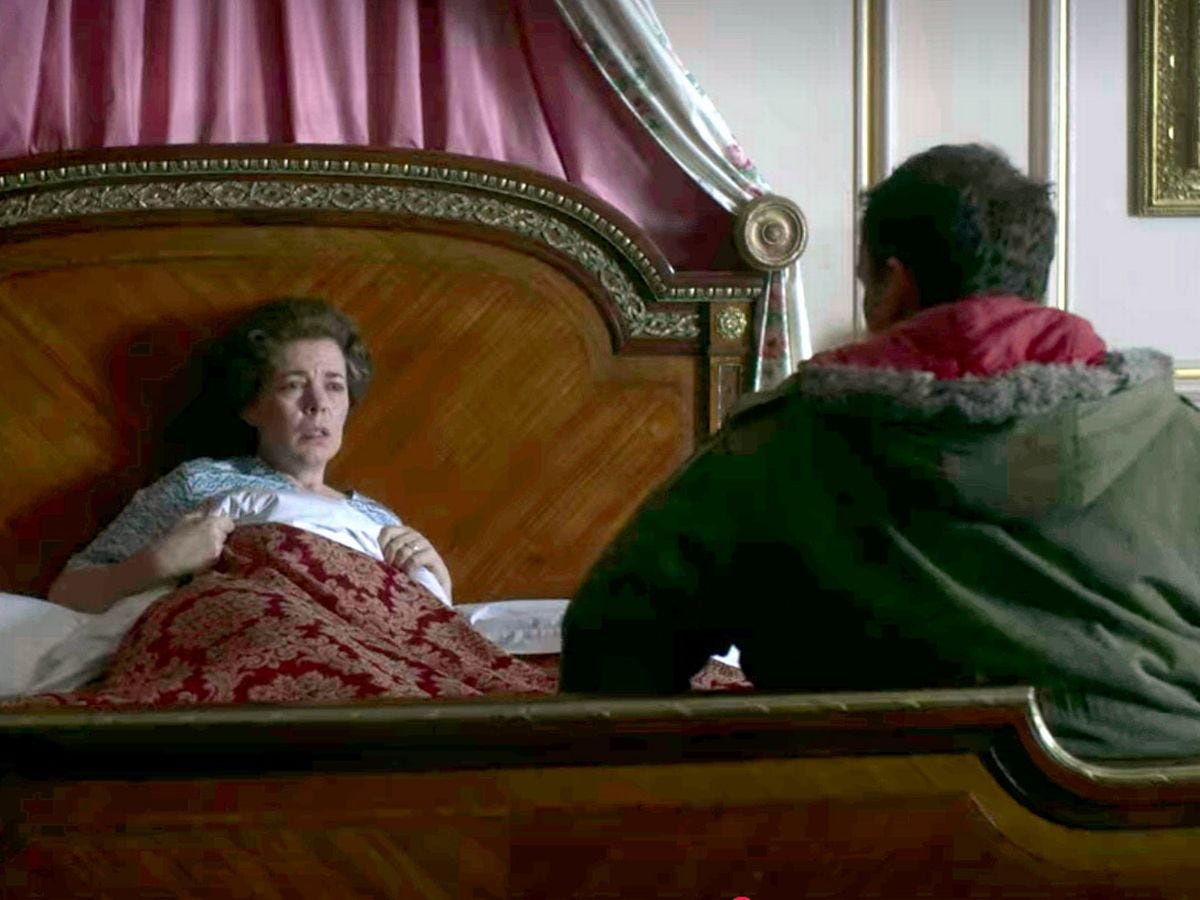
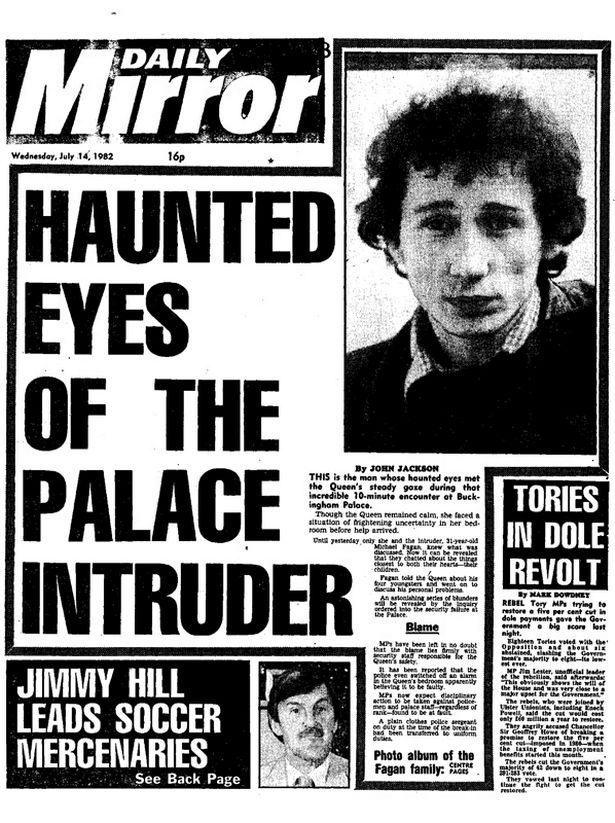
In fact, the Queen did leave the room immediately to seek security. The Queen phoned the palace switchboard twice for police, but none arrived, so she used her bedside alarm bell. She also beckoned a housemaid in the corridor, who was quickly dispatched to seek urgent help. The duty footman, Paul Whybrew, who had been walking the Queen's dogs, arrived, followed by two policemen on palace duty, who promptly removed Fagan. The incident had happened as the armed police officer outside the royal bedroom came off duty before his replacement arrived.
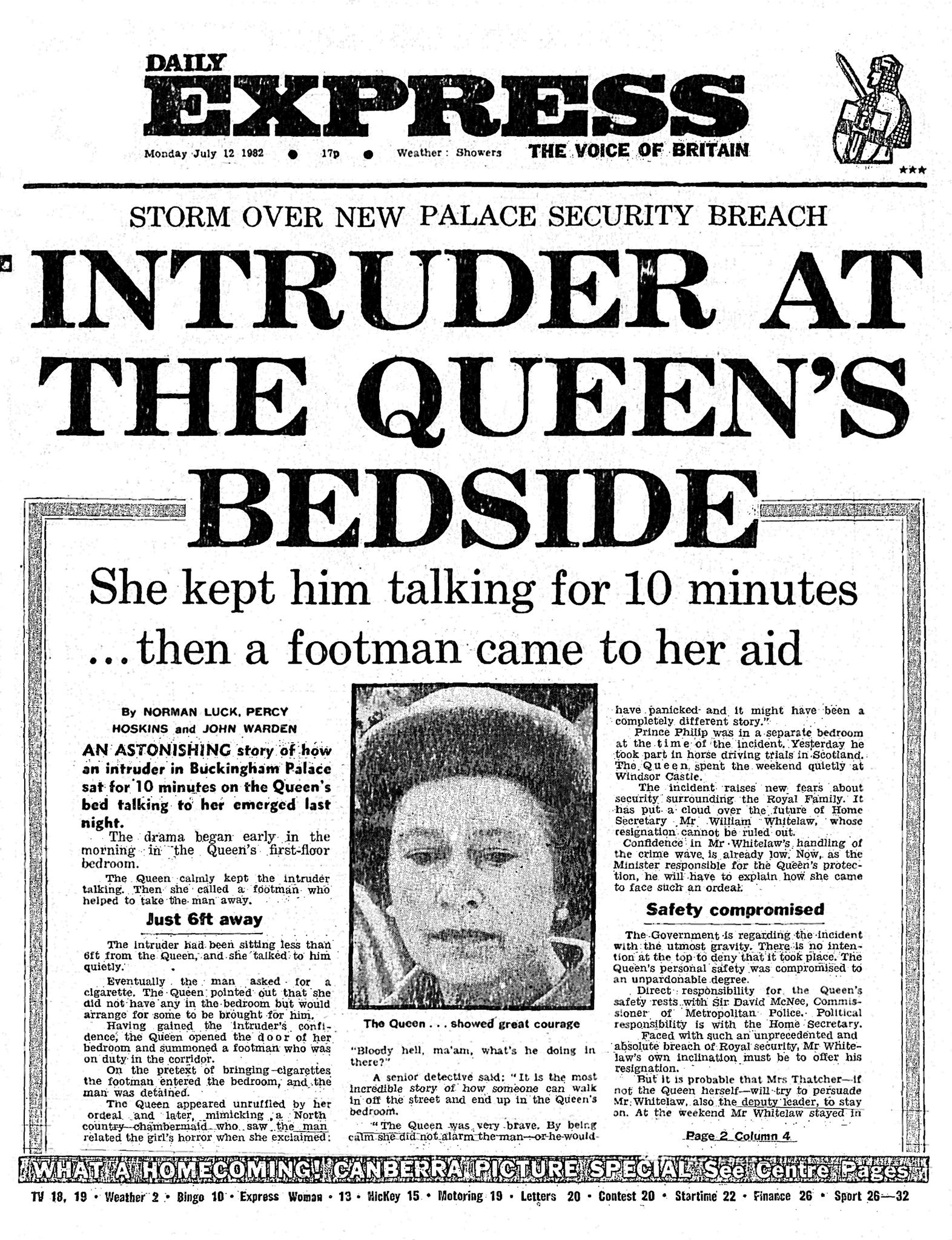
A subsequent police report was critical of the competence of officers on duty, as well as a system of confused and divided command. The Home Secretary, who held sole responsibility for the police, William Whitelaw, offered his resignation but it was refused by the prime minister, Margaret Thatcher.
At the time of his arrest, Fagan's actions were a civil offense versus being a criminal act. Consequently, Fagan was not charged with trespassing, but a charge of theft was leveled against him due to his admission that he took and (partially) consumed a bottle of wine! In fact, it was not until 2007, when Buckingham Palace became a "designated site" for the purposes of section 128 of the UK's Serious Organized Crime and Police Act 2005, that trespass at the palace became an actual criminal offence.
Fagan's theft charge was dropped when he was committed for psychiatric evaluation several months after his arrest. In late July of 1982 Fagan's mother said, "He thinks so much of the Queen. I can imagine him just wanting to simply talk and say hello and discuss his problems." Fagan spent three months in a psychiatric hospital before being eventually released in January 1983.
Fagan led a chequered life after the palace incident. In 1983 Fagan recorded a cover version of the Sex Pistols song 'God Save the Queen' with punk band the Bollock Brothers (listen to Fagan performing the song Sprechgesang style here:
In 1984 Fagan attacked a policeman at a café in Fishguard, Wales, and was given a three-month suspended sentence. In 1987 Fagan was found guilty of indecent exposure after a woman motorist saw him running around with no trousers on. Fagan was imprisoned in 1997 for four years after he, his wife and their 20-year-old son Arran, were charged with conspiring to supply heroin.
After the death of the Queen on September 8, 2022, Fagan told reporters that he had lit a candle in her memory at a local church.
*The Independent, February 19, 2012